Get Full Government Meeting Transcripts, Videos, & Alerts Forever!
Get email alerts on the Vibrant Denver Bond topic
No spam. Unsubscribe anytime.
Denver committee forwards $410 million Vibrant Denver bond issuance and TriUnity program‑management contract to full council
Summary
The finance and business committee voted to forward an ordinance to issue two series of Vibrant Denver bonds totaling $410 million and a resolution approving a seven‑year, $45 million program‑management contract with TriUnity Inc.; officials described timelines, tax‑exempt spend rules and a 20% MWBE participation goal.
The Finance and Business Committee of the Denver City Council on Jan. 13 voted to forward to the full council an ordinance to issue two series of Vibrant Denver bonds totaling $410,000,000 and a resolution to approve a proposed program‑management contract with TriUnity Inc.
Patrick Reilly, bond program manager in the Department of Finance, told the committee the first issuance is sized to keep the city on track to deliver the six‑year Vibrant Denver program. "For this first issuance, we are looking at $410,000,000," Reilly said. He said the issuance will be split between tax‑exempt and taxable series to meet federal private‑use rules and local delivery needs.
The presenters framed the bond rollout around three mayoral commitments announced Nov. 5: projects should begin advancing to their next stage in 2026 (community engagement, design or construction as appropriate), a public project dashboard by 2026 and project completion and public opening by Dec. 31, 2031. Reilly outlined a schedule that contemplates a market sale and a closing in early March 2026, subject to standard market adjustments.
City staff described the financing mix and spend rules that shaped the plan. Reilly said about $217,500,000 is planned as tax‑exempt and $192,500,000 as taxable for the first issuance; tax‑exempt proceeds have an internal requirement to spend 85% within three years and 100% within five years. "We had 1,000 projects that were submitted," Reilly said, describing how projects were prioritized and routed into the city's six‑year capital improvement plan for further vetting.
Officials walked the committee through portfolio allocations in the first tranche, noting roughly $93,000,000 for transportation and mobility and significant near‑term funding for parks, trails and library projects intended for immediate design and construction work. Staff said some partner‑led projects will be administered as funding assignment agreements (reimbursable contracts administered through partner agencies).
The committee also reviewed the proposed program‑management contract with TriUnity Inc. Reilly said the city selected TriUnity, a Denver‑based firm that began as an MWBE and was later acquired by Lochner, to provide program management with a seven‑year contract (to cover a six‑year program plus closeout) and a $45,000,000 capacity. "They have committed to a 20% MWBE participation goal," Reilly said, comparing that target to prior bond program contracts that achieved about 15%.
Christopher Federico, capital financial administrator with the Department of Finance, explained why some projects will be issued as taxable bonds. "If we do have any sort of anticipated private use in any of the facilities that would make us issue taxable bonds," Federico said, citing management arrangements and naming rights as potential private‑use examples. He described federal limits the city uses for related and unrelated private use (10% and 5%, respectively) and said issuing taxable bonds can preserve operational flexibility for facilities with private management.
Council members asked about community engagement, how projects were selected from the capital improvement project submissions and whether the city will provide communication toolkits for longer, complex projects. Jackson Brockway of the Capital Planning and Programming Division confirmed the six‑year CIP will be updated, on its regular cycle, to incorporate Vibrant Denver projects and that staff will brief council during that process. Reilly said engagement will be tailored by project and coordinated with relevant agencies and councilmembers.
A councilmember asked specifically about the Senior Tech Lab space; Reilly said the project is included in the first issuance and staff are working with real estate to fit the senior center's needs, while noting the first issuance may not fund full buildouts of very large spaces.
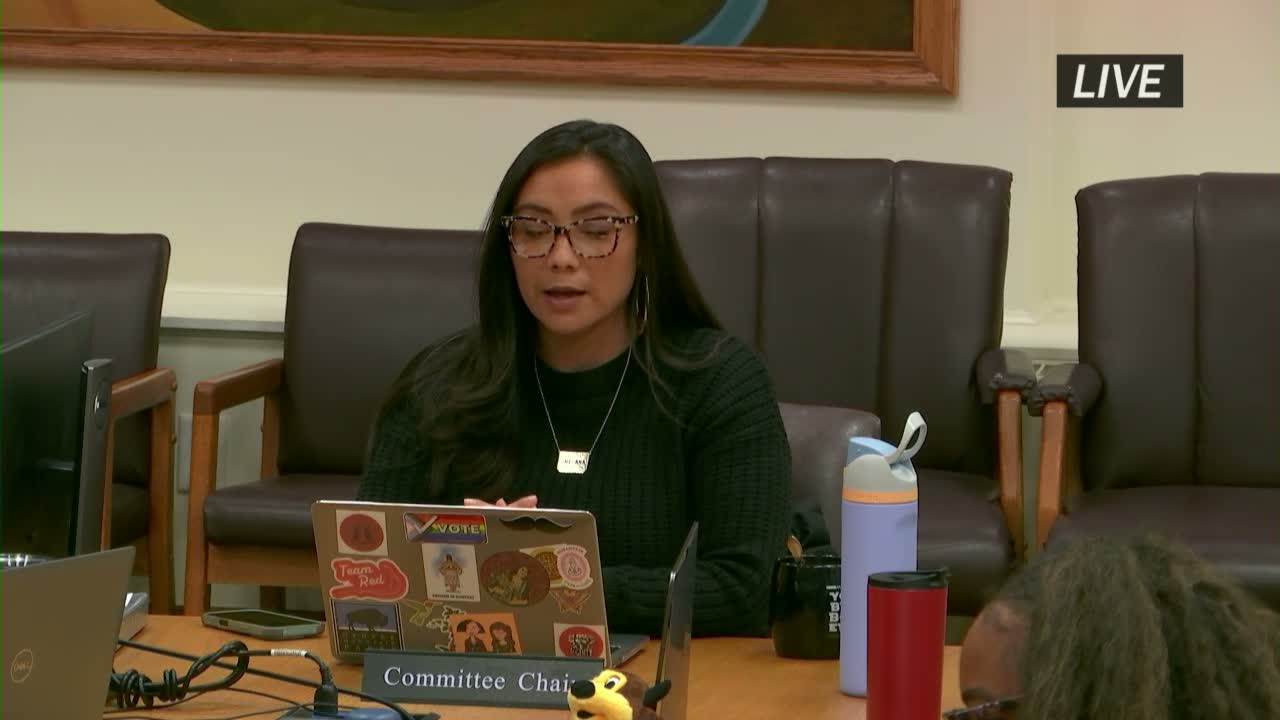
After the discussion, Chair Selena Gonzalez Gutierrez asked for a motion; the committee moved and seconded to forward the ordinance and the TriUnity contract to the full council (motion moved by Council President Sandoval and seconded by Councilman Hines). No committee roll‑call vote or tally was recorded in the committee minutes; the items will proceed to the full council for formal action.
The committee adjourned after confirming there was nothing on consent.