Get Full Government Meeting Transcripts, Videos, & Alerts Forever!
Get email alerts on the Homelessness Cold Shelter topic
No spam. Unsubscribe anytime.
Denver officials outline plan to restore cold-weather shelter capacity after 4040 Quebec contract loss
Summary
City staff told Mayor Mike Johnston and council that a December rejection of the 4040 Quebec contract cut 24/7 cold-weather shelter capacity from 670 to 170 beds; officials proposed lowering occupancy at the site, separating navigation services from shelter functions, and seeking a new agreement with Bayaud Works while pursuing more sites and briefings for council.
Denver Mayor Mike Johnston and city staff on Monday told the City Council that a December vote affecting the 4040 Quebec contract sharply reduced available 24/7 cold-weather shelter capacity and described short- and longer-term steps the administration is considering to restore services.
Cole Chandler, senior adviser on homelessness in the mayor’s office, said the city had planned for 900 single-adult beds this season and had pulled together 670 24/7 beds heading into winter. "With the no vote that took place on the 4040 Quebec contract that happened on December 8, our capacity is seriously limited," Chandler said, adding the city’s operational 24/7 bed capacity fell to about 170.
Why it matters: City officials said the shortfall has contributed to people remaining outdoors during extreme cold, especially in Northeast Denver, and urged council to support administration steps to mitigate risk while longer-term plans continue.
What the city proposed: Chandler outlined a package of changes the administration is considering for the 4040 Quebec site, including launching a planning process to fully activate navigation-center services by next cold-weather season (which would remove ballroom space from future cold-shelter use); lowering target occupancy at the site from a planned 200 to about 100–150 to prioritize walk-in residents of nearby neighborhoods; and keeping navigation services and shelter functions physically separate at the site.
Chandler asked council for support for a revised operational agreement with Bayaud Works, the provider the city has used for shelter operations, and said the administration is prepared to reactivate sheltering at the site in the near term while contract work proceeds. "We are requesting council support for a new improved agreement with Bayaud Works at this site," Chandler said.
Why alternatives are challenging: Mayor Johnston and staff said a key constraint is provider capacity. The city’s contracted provider model limits how many distinct sites one vendor can staff. Chandler and other staff said Bayaud’s on-call contract covers a limited number of locations and that operating many smaller sites would create staffing and life-safety challenges. Jeff Kositzky, deputy director at HOST, explained the city can draw on a separate emergency contract in extreme events — but that contract costs about "four times as much per hour" and is reserved for declared emergencies (for example, when temperatures dip well below zero and the Emergency Operations Center stands up).
Council reaction and equity concerns: Council Member Lewis (identified in the meeting) strongly objected to use of 4040 Quebec for sheltering, saying she had been told previously that the site would not be used for cold-weather shelter and urging staff to find options across the city. "I reject that quite frankly," she said in response to the administration’s framing, and pressed for alternatives including the Coliseum and Dream Center. Other councilmembers emphasized the need to distribute sites across districts and to brief members regularly.
Operational details and constraints: Staff said they initially targeted 900 single-adult beds, assembled 670 24/7 beds, and relied on overflow plans to reach the remainder. The December vote on the 4040 Quebec contract led to operating without that site, dropping active 24/7 beds to roughly 170. The administration said it is exploring reduced occupancy at 4040 Quebec, clearer separations between navigation services and sheltering, and additional sites listed on internal planning materials (referenced as "slide 13" during the briefing). Real-estate staff cautioned that many potential spaces fail life-safety or lease-indemnification requirements or lack partners willing to lock space for months.
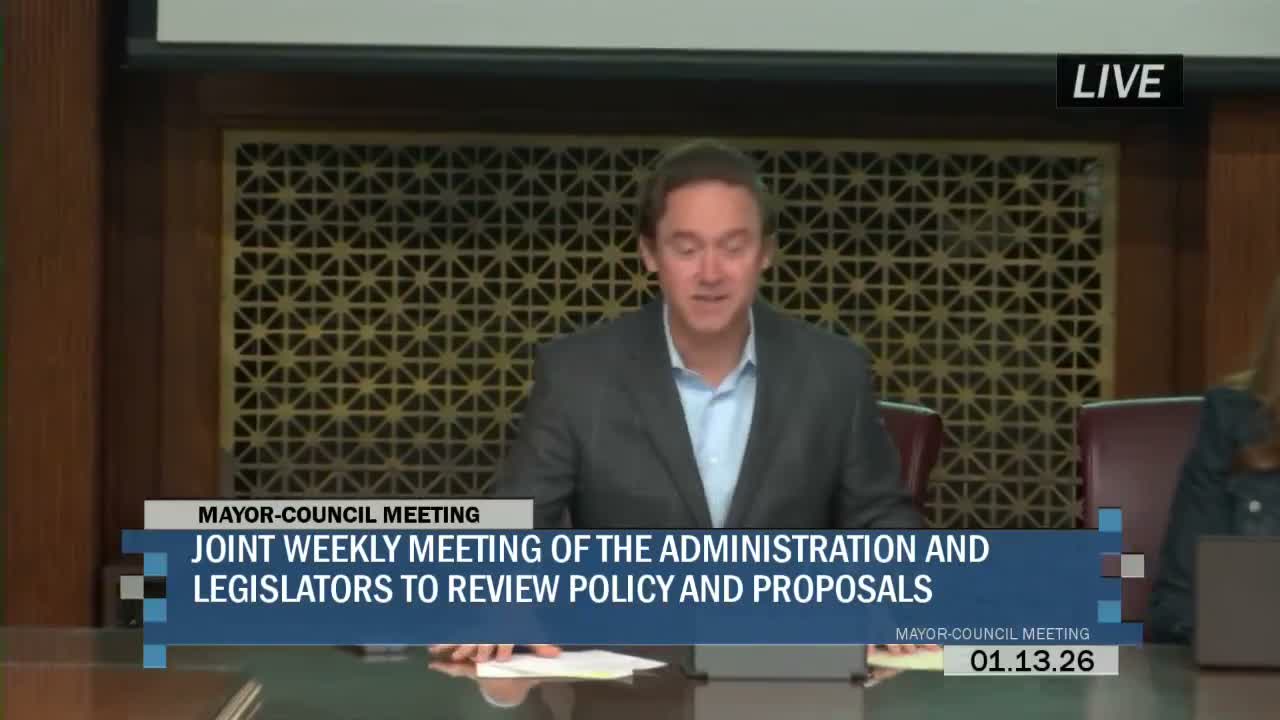
Next steps: Staff offered to schedule additional briefings with council members and asked for support to move a new contract forward. Mayor Johnston asked for a motion to enter an executive session to receive legal advice about ongoing contract negotiations; the meeting record shows that motion was entertained but no vote on the contract itself is recorded in the public portion of the transcript.
The city’s proposals and constraints are operationally focused: they aim to balance immediate life-saving sheltering needs during cold weather with longer-term goals to expand navigation services and avoid mixing client populations in shared spaces.