Get Full Government Meeting Transcripts, Videos, & Alerts Forever!
Get email alerts on the Fleet Electrification topic
No spam. Unsubscribe anytime.
Laguna Beach council directs staff to pursue EV charging, seeks grants to cut net cost
Summary
Council approved staff to issue an RFP for EV charging construction and to pursue SoCal Edison and other incentives after hearing an 18-month implementation plan that estimates $18.78 million in capital costs over five years and up to $4 million in incentives.
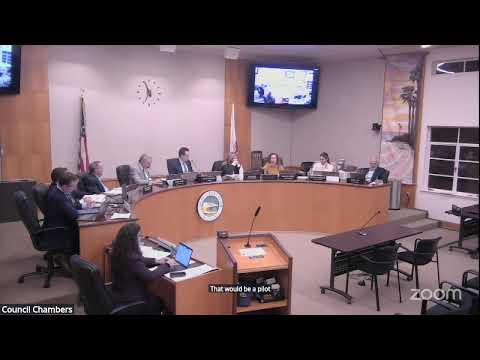
Laguna Beach city officials voted to direct staff to issue a request for proposals (RFP) for electric vehicle (EV) charging construction and to pursue utility and state incentives supporting a five‑year fleet electrification plan.
The vote followed a staff presentation and consultant briefing that outlined a phased plan to replace portions of the city’s 185‑vehicle fleet over 15 years and to install charging infrastructure at City Hall and the city’s maintenance courtyard. Assistant City Engineer Frank Lopez introduced the plan and Emma Sullivan, program manager with consultant ICF, described the near‑term implementation steps, costs and funding opportunities.
The plan recommends electrifying about 22 vehicles in the first five years and installing 47 chargers (16 at City Hall, 31 at the Courtyard). Vehicle capital costs for that five‑year window were estimated at about $12.87 million; charger hardware at about $2.87 million; and “make‑ready” electrical upgrades about $335,000, some of which (up to $268,000) could be reimbursed through the Southern California Edison (SoCal Edison) Charge Ready Transport (CRT) program. The consultant said the plan’s total capital cost is about $18,780,000 and that available incentives could reduce net city spending by roughly $4,000,000. Comparing fully to an internal‑combustion (ICE) alternative, the electrified scenario is roughly $7 million higher in capital costs before incentives and roughly $2.4 million higher after estimated incentives.
Staff and the consultant told the council the city could realize lifecycle savings from lower fuel and maintenance costs, and that incentives vary by vehicle class. Trolleys, which accrue heavy mileage, were highlighted as having high capital cost but greater operational savings; ICF said electric trolleys make up a disproportionate share of the vehicle capital cost in the recommended package. The consultant also said federal funding is less certain and that quicker applications improve chances for awards.
Council members pressed staff on affordability and phasing. Staff said the city can change the acquisition mix before signing any SoCal Edison agreement; however, if the city signs the CRT agreement it must commit to purchasing at least two electric vehicles within 18 months to remain eligible. Staff said SoCal Edison indicated available CRT funding likely runs through 2026 and that the utility’s make‑ready rebate program requires the equipment be in active use for a period (the consultant cited a 10‑year net expectation tied to the rebate timeline).
Councilors discussed options to defer the costly trolley purchases, lease vehicles, or pursue different procurement strategies to reduce upfront exposure. ICF said that excluding trolleys from the near‑term rollout could reduce net additional spending by about $6 million. Transit staff noted limited manufacturer competition for trolley‑style EVs and said a small pilot of two EV trolleys and two existing‑fuel trolleys was under consideration to evaluate real‑world performance.
Public commenters and councilors asked about coordination with other local utilities and agencies, relocatability of chargers if a future parking structure is built, and potential inter‑agency collaboration (for example with the local water district). Staff said chargers are relocatable with planning, that SoCal Edison performs upstream facility upgrades in many cases, and that staff will coordinate designs with other facility plans and the facilities master plan to avoid future rework.
The council approved the staff recommendation to issue an RFP for EVSE (electric vehicle supply equipment) design and construction, to pursue and, if appropriate, approve the SoCal Edison CRT agreement, and to return with contractor selection and a funding plan. Council discussion and staff remarks indicated a staff return with funding details to the April–May timeframe and that the city would seek to maximize state and utility incentives to lower net cost.
Votes at a glance The council moved and approved the recommended action to issue an RFP and pursue the SoCal Edison agreement; the motion passed by voice vote (ayes recorded). No named nay votes were recorded in the transcript.
Why it matters The plan aims to reduce municipal greenhouse gas emissions, comply with state clean‑fleet rules and lower long‑term operating costs, but it requires substantial upfront capital or grant funding. The council’s direction begins procurement and grant work while preserving options to adjust vehicle mix and timing before committing to purchases.
What’s next Staff will issue the RFP for EV charging construction, continue negotiations and the CRT application with SoCal Edison, and return to council in April or May with contractor selection and a detailed funding recommendation.