Get Full Government Meeting Transcripts, Videos, & Alerts Forever!
Get email alerts on the Zoning Local Law D topic
No spam. Unsubscribe anytime.
Board continues public hearing on zoning overhaul; members discuss limits on dispensaries and remove marinas from waterfront zone
Summary
The Red Hook Town Board continued the public hearing on Local Law D (zoning updates) to Jan. 29 after hearing public comment urging more restrictive rules for cannabis dispensaries and staff and counsel advising removal of marinas from waterfront-conservation uses to maintain passive riverfront objectives.
The Red Hook Town Board continued its public hearing on proposed Local Law D (zoning amendments) to Jan. 29 after a lengthy discussion of waterfront uses and cannabis-dispensary rules.
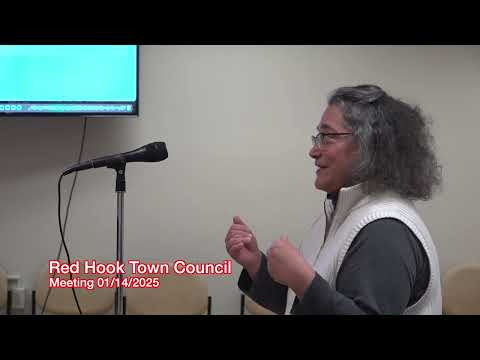
Public comment: Laurie Urban, who identified herself as “president of your town,” urged caution on rules that would ease siting of cannabis dispensaries, saying the town ‘‘doesn't need super duper loose or easy zoning with regard to cannabis dispensaries’’ and asking the board to consider whether multiple dispensaries would be appropriate in a small community.
Board discussion and staff analysis: Town counsel and planner Ted (remote) presented an environmental and LWRP (Local Waterfront Revitalization Program) analysis tied to a revised draft (d3). Ted recommended removing commercial marinas from permitted uses in the waterfront-conservation area, explaining the town’s 1995 LWRP and the comprehensive plan prioritize ‘‘passive and water-dependent recreation and land-extensive open space uses’’ that minimize disturbance. He reported there are too few contiguous, suitably sized parcels in Barrertown that could physically or legally support a marina; most waterfront lots are small residential parcels and a large historic trust property (Edgewater/Edgewater Estate) is museum land and unlikely to be available for commercial marina development.
Ted summarized the LWRP/CFA reasoning: marinas are water-dependent uses but must also be compatible with local planning objectives; in Red Hook those objectives emphasize low-impact public access and scenic corridors, not commercial marina expansion.
The board and staff also discussed several clarifications in d3, including tightened definitions of boat ramps, boat clubs and mooring restrictions (a 1,500-foot no-mooring limit referenced in the draft subject to applicable state/federal permits) and removal of references to federal wetlands delineations that would be impractical to administer locally. The board confirmed it would file a Coastal Assessment Form and an LWRP consistency determination as part of the continued hearing.
Why it matters: the zoning update shapes where river access, small-scale recreation, and new commercial uses like cannabis retail can locate. The draft aims to balance potential economic uses with the comprehensive plan’s stated preference for ‘‘windows on the Hudson’’ and a continuous riverfront corridor emphasizing public access and limited disturbance.
Next steps: the board continued the hearing to Jan. 29 and instructed staff to incorporate written comments received, finalize the LWRP consistency materials, and circulate revised language for boat-related definitions and mooring rules before the next hearing.