Get Full Government Meeting Transcripts, Videos, & Alerts Forever!
Get email alerts on the Public Safety Emergency Communications topic
No spam. Unsubscribe anytime.
Douglas County hears 911 center and emergency management overview; officials flag radio contract and FIFA 2026 planning
Summary
Douglas County commissioners received an operational briefing from the Emergency Communications Center and the county Emergency Management office on staffing, funding, radio-system contracts and preparations for major events including FIFA 2026.
Douglas County commissioners heard a joint briefing Jan. 29 from the Emergency Communications Center and the county Emergency Management office on staffing, funding sources, radio-system infrastructure and planning for large events, including FIFA 2026.
The update, presented by Tony Foster, director of the Emergency Communications Center, and Robert Binecki, director of Emergency Management, covered how the 911 center is funded, staffing levels and response-time metrics; plans to renew a long-term Motorola P25 radio-service contract; and forthcoming exercises and trainings for resource management and lithium-ion battery incidents.
Foster said the center is funded through a city–county cooperative agreement and a state 911 fund. "Currently 33.33% of the operating budget is provided by Douglas County, and the City of Lawrence is at 60%," he told commissioners. He said a state 911 funding source provides about $620,000 a year but, by statute, that money is restricted to technology and cannot be used for personnel.
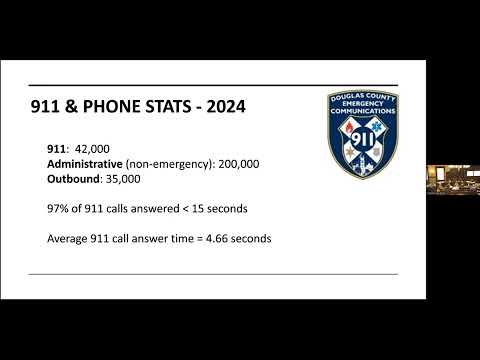
Foster described the center's staffing and performance: budget authority covers 35 positions, with 31 filled; the center runs two 12-hour shifts each day; and it met National Emergency Number Association benchmarks on answer times in 2024. "We are currently at 97% within 15 seconds," Foster said, adding the center's average 911 answer time was 4.66 seconds in 2024. He reported roughly 42,009 911 calls, about 200,000 nonemergency administrative calls and about 35,000 outbound calls in 2024.
Commissioners asked about turnover and pay. Foster said overall turnover for frontline staff over the past 18 months is "probably right about 15%," with most attrition occurring during training. He said the center's new starting wage following a pay study is $24.23 an hour.
On infrastructure, Foster described the county's radio system as a five-site P25 system that connects to a statewide core operated by KDOT and administered through the Kansas Highway Patrol. He warned commissioners that the county will face an expensive Motorola service-contract renewal in the coming years and that cybersecurity and added services since the original contract will increase costs. "We anticipate that Motorola service contract [costs are] going up substantially," a county staff member said during the presentation.
Binecki framed Emergency Management's role as planning, coordination and support rather than frontline response: "We coordinate and collaborate. We support first responding agencies. We're more behind the scenes," he said. He described the department's funding and staffing: two county-funded full-time positions (director and deputy); additional planner and program specialist positions funded through the Emergency Management Performance Grant (EMPG); and two duty officers who rotate one week a month to provide 24/7 after-hours coverage.
Binecki described the county's emergency operations center (EOC) and how the EOC supports incident commanders during large responses, such as the 2019 tornado. He explained that a local declaration of emergency is sought when local resources are exhausted and that such a declaration can be used to request state or federal assistance and to document reimbursement eligibility.
Both departments outlined preparations for major upcoming events and risks. Foster and Binecki cited FIFA 2026 as a planning focal point that will test interoperability and resource management. Binecki also highlighted concerns about lithium-ion battery fires and said the county is preparing trainings and a white paper; he noted planning for storage, transportation and disposal risks in the context of broader state discussions. The Emergency Management office listed federal grant programs and funding streams they routinely pursue or use, including EMPG, HMEP (Hazardous Materials Emergency Preparedness), BRIC and FEMA public-assistance programs.
Commissioners and staff discussed regional coordination and mutual aid. Binecki explained that Kansas uses an opt-in emergency management assistance framework so counties can request resources from others under established state processes; he said regional emergency managers meet regularly and that the state provides incident-support teams and coordination through the State Emergency Operations Center.
Presenters described several service changes and pilots already underway: the center now transfers appropriate calls to the 988 crisis line; the mobile response team has been dispatched through the 911 center since the prior year; and the county completed a Harvard Government Performance Lab review of alternate 911 responses and is considering incremental, controlled changes. Foster also said the center intends to implement a transcription and Spanish-translation tool from its vendor in 2025 to reduce reliance on external translators.
Commissioners asked for additional data and follow-up. Foster agreed to provide updated turnover and tenure figures from the center's annual report. A staff member asked Robert Binecki to bring an update on Gold Cup planning and related event coordination to a future meeting. The session concluded with invitations for commissioners to tour the ECC facilities.
No formal decisions or votes were taken at the Jan. 29 work session; county staff characterized the meeting as informational and noted that public comment and votes occur during the 5:30 p.m. business meeting.
The briefing included both operational metrics (staffing numbers, call volumes, response times) and forward-looking items (Motorola contract renewal, FIFA 2026 planning, lithium-ion training). Commissioners signaled interest in additional data on costs and staffing and in continued coordination across cities and regional partners.