Get Full Government Meeting Transcripts, Videos, & Alerts Forever!
Get email alerts on the Legislative Priorities topic
No spam. Unsubscribe anytime.
School Committee sets legislative priorities: student transportation, funding formula and high‑cost special education among top asks
Summary
At a Jan. 14 joint‑planning session, Portsmouth School Committee members reviewed and approved legislative priorities for 2025, including support for statewide transportation study outcomes, a request that the state assume the cost of transporting homeless students to their district of origin, calls to stabilize the state funding formula, and a bid
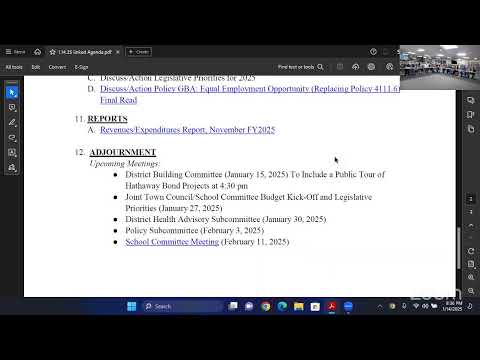
The Portsmouth School Committee discussed and approved a slate of legislative priorities for 2025 during its Jan. 14 meeting, highlighting student transportation, the state funding formula, and high‑cost special education funding among top items the committee will share with state legislators at the Jan. 27 joint meeting with the Town Council.
Major items discussed and actions taken
- Statewide transportation study and related changes: The committee supported continuing to press legislators for outcomes of the statewide pupil transportation study that could reduce costs and ease driver shortages. Specific items discussed included increasing the allowed number of passengers in pupil‑transport vehicles (from 7 to 10, the Massachusetts standard), shortening certification training for drivers who already hold CDLs, and creating a permanent temporary‑waiver process for out‑of‑state CDL drivers (a measure used during COVID). The committee approved these priorities and discussed close‑by policy tradeoffs.
- Homeless student transportation costs: Committee members voted to add language asking the state to assume the cost of transporting homeless students to their district of origin. That motion passed with a recorded unanimous vote (6–0) in the meeting transcript.
- State funding formula and caps on volatility: The committee asked for a more equitable funding formula and proposed a cap on large year‑to‑year percentage changes in state aid (language drafted for FY26), to reduce budgeting volatility for districts and municipalities.
- High‑cost special education: The committee again urged legislators to increase the high‑cost special‑education categorical fund so that districts receive greater reimbursement for expensive out‑of‑district placements. Members asked staff to supply the FY24 reimbursement figure for the record.
- Free school meals and unpaid lunch debt: The committee reiterated support for broader state action on school meals; members discussed models in other states and the local cost challenges caused by unpaid meal debt.
- Cell phone use in schools: The committee debated whether to ask the General Assembly to adopt a statewide restriction on personal devices in schools. A motion to add a legislative priority calling for a statewide policy failed on a tied vote (3–3). The committee chose instead to have the district policy work continue locally and to keep the committee informed about pending state legislation and potential pilot funding to support enforcement mechanisms.
- Broadband/Aquidneck Island high‑speed internet: The committee retained a request that the state and federal partners prioritize high‑speed internet expansion on Aquidneck Island to support student access at home and in school.
Other items placed on a “keep us informed” list included composting and waste‑reduction programs, pesticide‑use enforcement on school property (committee asked representatives to follow up on enforcement of the state task force recommendations), and career development tied to green and blue economy jobs.
Why it matters: Transportation and special‑education costs are major line items in district budgets; changes at the state level could materially affect Portsmouth’s FY26 budget and long‑term planning. Committee members said the priorities will be forwarded to the town council and the district’s state representatives ahead of Jan. 27.
Votes and next steps
The committee took recorded, item‑level votes during the discussion: the addition asking the state to assume homeless‑student transportation costs passed unanimously (6–0); the proposed statewide cell‑phone policy request failed on a 3–3 tie and will instead be tracked as pending state activity. The superintendent and staff will finalize the priorities document and circulate it to the town council and legislators before the Jan. 27 joint meeting.