Get Full Government Meeting Transcripts, Videos, & Alerts Forever!
Get email alerts on the Development Bond topic
No spam. Unsubscribe anytime.
Council deadlocks on Shoreline Properties bond reduction after resident complaints
Summary
The West Warwick Town Council tied 2–2 and failed to approve a planning-board recommended reduction of a performance bond for Shoreline Properties’ Carlton Avenue subdivision. Council members raised neighborhood complaints about dust, debris and unfinished work; the planning board and town engineers had proposed a $438,800 hold to cover remaining (
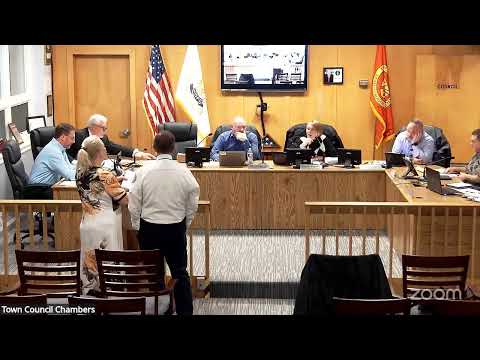
The West Warwick Town Council tied 2–2 Tuesday and therefore did not approve a planning-board recommendation to reduce Shoreline Properties’ performance bond for the Carlton Avenue (Car) subdivision.
The motion before the council asked that the bond be reduced from an original estimate of about $1,030,100 to $438,800 — a figure the town engineer, public works director and Kent County Water Authority identified as the estimated cost to complete outstanding sewer, roadway and water work. Because the vote resulted in a tie, the bond reduction did not pass and the larger bond amount remains in place.
The denial came after more than an hour of discussion in which Councilman Licciardi, who said he lives near the development, described repeated neighborhood complaints about tall grass, dust, debris tracked onto public roads, and what he characterized as intermittent and inadequate dust control measures. “Grass was mowed… approximately 3 foot high,” Licciardi said during remarks to the council, and he described “chunks of dirt” and sand that had been tracked onto adjacent streets, posing hazards for pedestrians and bicyclists.
Town Solicitor Al explained the legal framework the council must follow. He told the council that state statute and the town’s subdivision regulations permit two primary methods for guaranteeing completion of subdivision improvements: (1) the developer posts a guarantee covering the entire project until completion, or (2) the developer posts a surety that the planning board sets and the professionals (town engineer, public works director, water authority) itemize. Al said the planning board’s role is to determine the proper guarantee and to recommend reductions to the council when appropriate. He said the planning board’s original professional estimate was $1,030,100 and that the experts later submitted a reduced estimate of $438,800 for the work remaining.
Jeff, the town engineer, described the cost-estimating method for the reduced figure: contractors’ current unit prices for asphalt, concrete and other materials multiplied by measured quantities; he said the consultant team inspected the site and cross-checked quantities. Jeff and other officials told the council that the $438,800 figure breaks down roughly as $284,000 for sewer work, $146,800 for public-works items and $8,000 for the water authority.
Developer and project representatives said some work remains. Jason, speaking for the builder, said three houses are framed, others are under construction and some foundations remain; he and the engineer said sidewalks, landscaping and a top coat of asphalt remain outstanding. Council members asked about pressure testing of water mains and the risk that future leaks could require further repairs; the engineer said any failed pressure tests would have to be corrected under contract.
Council members offered competing views on the council’s discretion. Some members said the council was bound by the planning board and experts’ numbers and that statutory language leaves little discretion. Others, including Licciardi, urged the council to weigh neighborhood health and safety complaints and to consider holding a larger portion of the bond until nuisance issues (dust control, roadway cleanup) were resolved.
When the matter reached a vote the roll produced two yes votes and two no votes; the tie meant the council did not approve the planning-board recommended reduction and no bond money was released.
The council did not adopt additional enforcement conditions on the bond at that meeting. Council members and staff suggested other enforcement channels — building-code citations, stop-work orders or direct enforcement by the building official — to address specific nuisance complaints, but no new formal directive was voted.
The planning board recommendation, the engineering breakdown and the developers’ remaining scope of work will remain on record for future council consideration. The developer may seek to return with additional documentation or to appeal planning-board findings through the administrative processes established in the subdivision regulations.
Votes and procedural details were recorded during the Feb. 4 council meeting; the planning-board written recommendation and the engineers’ itemized cost estimate are on file with the town planning office.