Get Full Government Meeting Transcripts, Videos, & Alerts Forever!
Get email alerts on the Equity Mwbe topic
No spam. Unsubscribe anytime.
Council questions $ increase to United Minority Contractors contract tied to Forever Home Durham
Summary
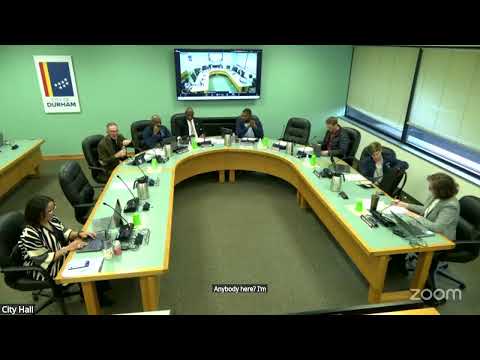
Council members pressed staff about a sizable amendment to a contract with United Minority Contractors of North Carolina to support MWBE participation in Forever Home Durham projects, asking for the original contract, performance data and a clearer explanation of why funds are being drawn from a dedicated housing fund.
Council members probed staff on Feb. 6 about Amendment No. 1 to contract No. 18421 with United Minority Contractors of North Carolina (UMC-NC), which would add time and money to a services contract intended to boost minority- and women-owned business (MWBE) participation in the city's housing investments under Forever Home Durham.
Reginald J. Johnson, director of the Community Development Department, said the city set 11% minority-owned and 7% women-owned participation goals that predate the bond program and that, because Forever Home Durham and related federal funding trigger Section 3 and Davis-Bacon compliance, the task is administratively complex and requires outside assistance. He said the work involves outreach to MWBE firms, training and bid-preparation assistance and compliance monitoring for federal wage and workforce rules.
"One of the things that we wanted to do as a community was make sure and ensure that as part of affordable housing creation, that minority and women owned businesses were included," Johnson said.
Council Member Cook, who pulled the consent item for discussion, said the amendment memo contained few details and asked why the city was spending housing-dedicated funds on a contractor to identify and prepare subcontractors rather than building that capacity in-house. UMC-NC project lead Renee Jones described the contract's three primary functions: outreach to MWBE firms, assistance to general contractors and developers to implement workforce/Section 3 plans, and Davis-Bacon compliance monitoring.
Council members asked staff for additional materials before taking final action: the original contract, a clearer breakdown of deliverables and expenditures to date, and updated performance numbers showing whether the city is meeting its MWBE participation goals. Staff said they would provide those documents after the meeting; Johnson said the city had in some cases met or exceeded the goals (staff later reported program-wide participation rates of about 13% for minority-owned firms and 12% for women-owned firms across the counted set of contracts), and that the amendment was written as a funding-and-time extension rather than a scope change.
Several council members said they support the policy goal but need more detailed backup to evaluate the proposed increase because the money derives from housing-dedicated funds. Council members also asked whether local nonprofit or business organizations could provide similar services and whether the city had vetted other firms; staff said the work followed an RFP process and UMC-NC was chosen from multiple proposers.
Ending: Staff agreed to provide the original contract and a data packet showing MWBE spend by geography and vendor to the council so members could review the amendment and the program's results before a final vote.