Get Full Government Meeting Transcripts, Videos, & Alerts Forever!
Get email alerts on the Human Services Budget topic
No spam. Unsubscribe anytime.
Columbus allocates $10.8 million to human services; city launches cash-transfer pilot
Summary
Deputy Director Hannah Jones presented a $10.8 million human services general fund budget for 2025 and described plans to continue the Elevate grant program and launch a two-year Economic Mobility Accelerator that will pilot conditional cash transfers.
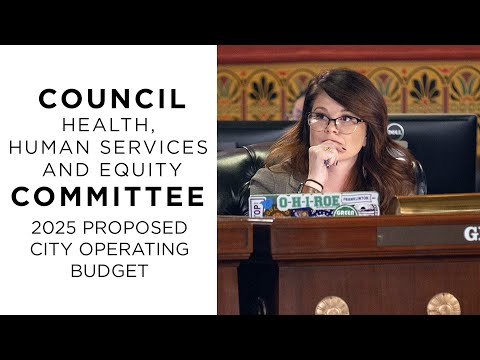
Columbus City Council’s Health, Human Services & Equity Committee heard the Department of Development’s human services budget Friday, with Deputy Director Hannah Jones saying the 2025 general fund request is $10,800,000.
The request includes about $811,000 for staff and roughly $10,000,000 to go directly to nonprofit human services programming, Jones told Chair Melissa Green and committee members. “Our human services general fund budget is proposed at $10,800,000,” Jones said.
The administration plans to maintain the Elevate grant portfolio and begin the Economic Mobility Accelerator, a two‑year pilot of conditional cash transfers that Jones described as intended to “accelerate the economic mobility of individuals in our community.” The department said Elevate funds organizations’ overall capacity rather than paying for specified programs; in the past year, 111 organizations served roughly 10,000 residents through Elevate cohorts.
Why it matters: Council Chair Melissa Green framed the hearing by warning of potential state-level funding cuts and proposed Medicaid work requirements that she said could remove coverage from tens of thousands of Ohioans. Green said the city faces “an absolutely pivotal moment” and that local investment in human services is a form of infrastructure.
Details and next steps: Jones said the city awarded $4,200,000 annually to agencies providing homelessness and housing‑stability services and $2,900,000 to 33 agencies providing ancillary supports. The department plans to fund the third and final year of Elevate 2 in 2025 (64 agencies) and to release a community‑open application for a new Elevate competitive process—“Elevate All”—in the second quarter of 2025 with funding beginning in 2026.
On the cash‑transfer pilot, Jones said the city is finalizing program design with six partner agencies and anticipates participant payments beginning by the end of the first quarter of the year. She described the program’s goals as creating a “replicable and viable” model for conditional cash transfers and said the city will convene a community of practice with providers including Motherful, Ohio State University, the Rise Together Innovation Institute and Nationwide Children’s Hospital.
What council asked: Committee members inquired how one‑time crisis responses (for example, Colonial Village or Sawyer Towers) are funded. Jones said those responses have historically been “over and above” the human services budget and noted the city’s relocation assistance code includes a replenishable fund that can serve residents when vacates occur.
Bottom line: The human services budget request focuses on continuing multi‑year capacity investments to nonprofits, preserving housing‑stability funding and piloting direct cash to test whether conditional transfers improve economic mobility. The department will follow up with application timelines and partner details as design finishes.
Ending: Jones invited additional questions and said the department would continue coordinating with council and nonprofit partners as program design and grant rollouts proceed.