Get Full Government Meeting Transcripts, Videos, & Alerts Forever!
Get email alerts on the Animal Control topic
No spam. Unsubscribe anytime.
Denver officials outline animal‑bite enforcement, urge focus on behavior and discretion
Summary
Denver Animal Protection and the City Attorney’s prosecution team briefed the Health & Safety Committee on enforcement under DRMC 8‑61, explaining bite‑severity guidance, a tiered response and high return‑to‑owner rates; the municipal public defender asked council to review Chapter 8’s criminal penalties and consider civil alternatives.
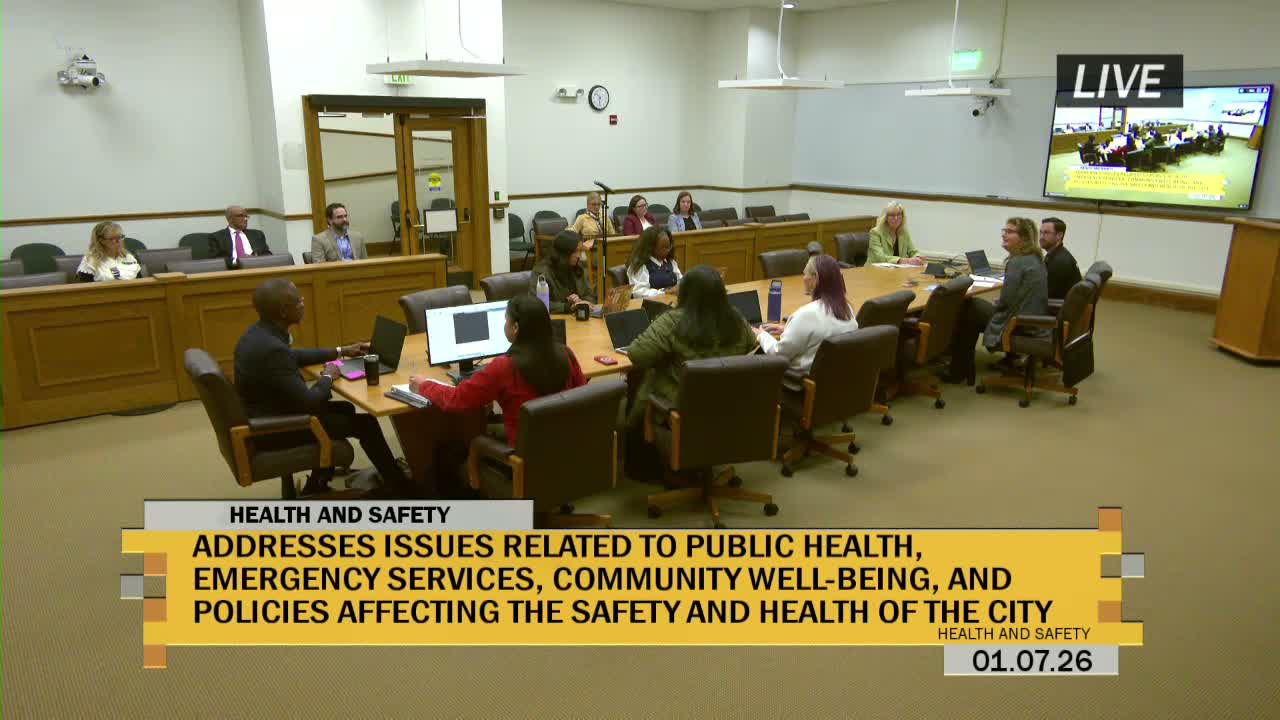
Denver’s Health & Safety Committee on Jan. 7 heard a detailed briefing from Denver Animal Protection and the city attorney’s prosecution team on how the city handles animal bites, enforcement and victim restitution.
Melanie Sobel, director of Denver Animal Protection, opened the presentation by saying the department uses an equity‑focused approach and takes animal‑bite enforcement “very seriously,” while also seeking to preserve the human‑animal bond where possible.
The presentation centered on Denver Municipal Code DRMC 8‑61, which the department said makes owners responsible for an animal that bites a person or domestic animal off the owner’s property or in a public business. Joshua Rolfe, a lieutenant with animal control, explained the department evaluates bites using the Ian Dunbar 1–6 scale, with level 1 described as “mouthy” behavior and level 6 meaning a fatality. Rolfe said lower‑severity incidents typically lead to management and education, while the scale recommends euthanasia in the most severe, multi‑victim or fatal cases.
Rolfe summarized the department’s reported bite data from Oct. 2024 to Oct. 2025 and noted a separate category of “unverified” reports in which investigators cannot recontact the victim. He told the committee that most unreported bites occur inside private homes and are not captured in those community figures. He also described Denver’s two codified classifications for animals: “Potentially Dangerous” (allowed to remain under permit and conditions, typically a minimum 36‑month permit) and “Dangerous” (illegal to maintain in the city and subject to surrender or rehoming outside city/county boundaries).
A prosecutor from the City Attorney’s Office, who identified themselves as the director of the prosecution section, described weekly staffing meetings with animal protection to triage cases and pursue restitution when appropriate. The prosecutor said many cases are resolved through deferred judgment plea agreements and education rather than criminal convictions, and that the office aims to direct more serious enforcement at higher‑severity incidents.
The municipal public defender raised a direct policy concern, telling the committee that ‘‘all of the Chapter 8 animal violations expose clients to 300 days in jail and a $999 fine’’ and asking council to review whether some offenses should instead be civil infractions or require a mens rea element. The city prosecutor responded that the office regularly consults with animal protection and may dismiss or decline to pursue charges where a nonowner (for example a dog walker or sitter) was responsible or where mitigating circumstances exist.
The presentation also covered community services: Sobel outlined increased shelter intakes (a reported 44% increase compared with 2019), higher owner surrenders and expanded programs including free vaccination/microchip clinics, vouchers for spay/neuter, a temporary pet‑housing program for people in crisis and plans to offer free training services in 2026. She highlighted that Denver’s return‑to‑owner rates are significantly higher than national averages — about 63% for dogs (national average cited at ~16%) and 23% for cats (national average cited at ~6%).
Council members pressed presenters on prosecutorial discretion, how the city enforces across jurisdictional borders (for example, when owners live outside Denver), and how Parks and Recreation coordinates enforcement of leash rules in parks. The department said it participates in a Metro‑area animal health group and collaborates with neighboring municipalities and county partners when possible; the prosecutor said cross‑jurisdiction cases are complex and may require Denver police or district attorney involvement.
The committee requested follow‑up information, including several years of sentencing and charging statistics and more detail on interagency coordination. Chair Daryl Watson asked staff to gather those materials for members.
The briefing concluded with committee members thanking the presenters and pledging follow‑up.