Get Full Government Meeting Transcripts, Videos, & Alerts Forever!
Get email alerts on the Homelessness topic
No spam. Unsubscribe anytime.
Denver committee clears Housing Central Command contracts to centralize rehousing services
Summary
The Community Planning and Housing Committee voted to forward three Housing Central Command contracts that would centralize navigation, stabilize households and fund unit acquisition and rent payments for 2026. Staff said HCC served 426 households in 2025 and aims to reduce average days to housing from 46 to 30 in 2026.
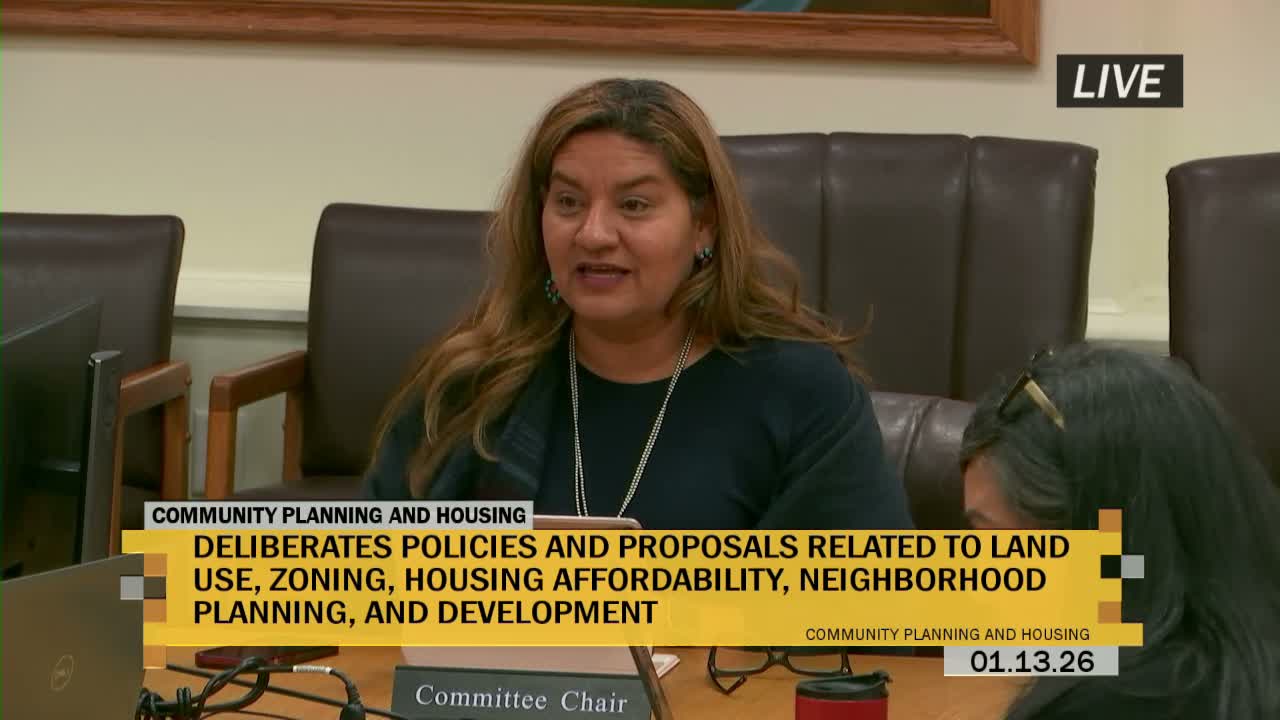
The Community Planning and Housing Committee voted to send three contracts for Housing Central Command (HCC) to the Denver City Council floor after a presentation and questions about program roles and data.
Assistant Director of Homelessness Resolution Evie Bencher told the committee HCC is an emergency‑management‑style response that coordinates rapid rehousing, vouchers and stabilization case management. She asked the committee to approve contract 25‑2152 for navigation (Community Firm, d/b/a Community Economic Defense Project), a stabilization contract with Colorado Coalition for the Homeless for $2,231,731 in 2026, and contract 25‑2153 with Housing Connector for rent payer and unit acquisition services for $2,049,386 in 2026.
Bencher said HCC served 426 households in 2025 — exceeding a goal of 399 — and that the program’s average time to housing was 46 days versus a 30‑day goal. “The goal of Housing Central Command is to maximize the resources that we have, connect folks to housing as quickly as possible to reduce their total amount of time they're spending homeless,” Bencher said. She described navigator and unit acquisition teams that accept referrals through the coordinated entry system, select units, support move‑ins and provide stabilization case management for approximately 12 months.
Committee members pressed staff on how HCC differs from the Homeless Management Information System (HMIS). Bencher and Director Midori Higa explained HMIS is a data repository; it ‘‘stores all of the information related to the services that are provided,’’ while the contracts fund staff who do outreach, navigation, landlord negotiation and case management. Higa added programs generally require rents at or below fair market rent and that Housing Connector must identify and compare units by size and neighborhood.
Councilmembers also asked about landlord relations and post‑placement supports after some community feedback that placements were not always a good fit. Bencher said Housing Connector maintains a landlord‑facing stability case manager and a support inbox to mediate issues, arrange mutual lease rescissions when appropriate, and handle maintenance or habitability tickets to prevent evictions.
On eligibility and prioritization, HCC staff said coordinated entry assessments are required for the community queue and that Metro Denver Homelessness Initiative and HUD standards govern prioritization. Staff offered to provide MDHI reports and placement data to council offices to better describe local prioritization and gaps.
The committee moved the three HCC items in a consent block and approved forwarding them to the council floor by voice/thumbs‑up vote. The committee also asked staff to return placement maps and performance details to council offices to address questions about district impacts and program “stickiness.”
Next steps: the contracts will proceed to the City Council for final action. Staff said they will follow up with briefings and placement data for council offices.