Get Full Government Meeting Transcripts, Videos, & Alerts Forever!
Get email alerts on the Traffic Enforcement topic
No spam. Unsubscribe anytime.
Maryland bill would let attorney general, local prosecutors sue out‑of‑state drivers over unpaid camera citations
Summary
Delegate Linda Foley’s HB 915 would let the Maryland attorney general or local state's attorneys pursue civil actions to collect unpaid automated‑enforcement citations issued to drivers from jurisdictions without reciprocal enforcement, a measure framed as reciprocity with Washington, D.C.’s Steer Act.
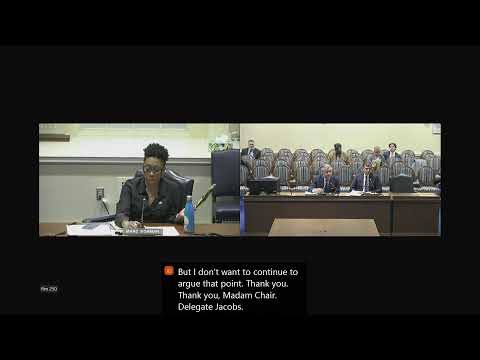
Delegate Linda Foley introduced House Bill 915, the "Out of State Driver Accountability Act," at a Feb. 20 hearing of the House Environment and Transportation Committee, asking the panel to give the measure a favorable report. The bill would enable the Maryland attorney general or a local state's attorney to bring civil suits to collect unpaid or overdue citations issued by automated enforcement (camera) systems against drivers registered in certain out‑of‑state jurisdictions, and would require quarterly reporting on out‑of‑state citations to the state Vision Zero coordinator.
Foley said the measure is a reciprocal response to the District of Columbia’s Steer Act and is intended to address unpaid automated‑enforcement citations that Maryland jurisdictions cannot currently collect. Citing a WBAL TV analysis of Baltimore City data, Foley said 43 percent of out‑of‑state drivers had not paid speed‑camera tickets on I‑83 and that between July 13, 2022, and March 31, 2023, about 237,000 speed camera tickets were issued on I‑83, with roughly 51,000 to out‑of‑state drivers and more than 22,000 remaining unpaid at the time of that investigation. Foley said one provision of the bill would allow the Maryland Department of Transportation to collect uniform ticketing data across local jurisdictions.
Supporters at the hearing urged broader scope but hailed the reciprocal approach. "We support this bill, but with the amendment that it should apply to all states," Ben Ross of the Action Committee for Transit told the committee, arguing that expanding coverage would address drivers who register vehicles out of state to avoid enforcement. Dan Reed of Greater Greater Washington and John Singh of Safe Roads Maryland also testified in favor, saying the bill would strengthen enforcement and road safety and allow jurisdictions to capture revenue lost to unpaid citations.
Committee members pressed on scope and mechanics. Several asked whether the bill applies only to automated enforcement; witnesses and the sponsor confirmed it targets camera citations and not citations issued during a traffic stop by an officer. Delegate Foley said the bill initially focuses on providing reciprocity with D.C. and on data collection; she expects amendments to allow jurisdictions without out‑of‑state citations to skip some quarterly reports and to authorize MDOT to aggregate statewide ticketing data. Concerns were raised about expanding reciprocity immediately to all states because of differing laws and possible reciprocal enforcement against Maryland residents if other states adopt different authority.
Members also asked how citations to rental and fleet vehicles would be handled: automated systems record registration information and citations typically go to the registered owner, who may then try to pursue the actual driver. Foley said rental‑car collection mechanics are beyond the bill’s scope and vary by jurisdiction; she characterized the measure as focused on owners of out‑of‑state tags and enabling civil collection when tickets are unpaid and not under legal contest.
The hearing record shows support from local safety and transit advocates and an intention by Foley to work with the Maryland Municipal League on a reporting amendment and to add MDOT data‑collection authority. No committee vote was taken at the hearing.
The committee will consider amendments that clarify which out‑of‑state jurisdictions are covered, specify reporting exemptions for jurisdictions with no out‑of‑state citations in a quarter, and authorize MDOT to aggregate statewide camera ticketing data.