Get Full Government Meeting Transcripts, Videos, & Alerts Forever!
Get email alerts on the Governmental Affairs.ethics topic
No spam. Unsubscribe anytime.
Committee hears bill to let Georgia Ethics Commission seek records from nonresidents in election probes
Summary
A House subcommittee heard House Bill 414 to extend the Georgia Ethics Commission’s enforcement reach to nonresidents involved in Georgia elections. The measure would let the commission seek documents outside the state through superior court orders; the committee held a hearing and plans a committee substitute in full committee.
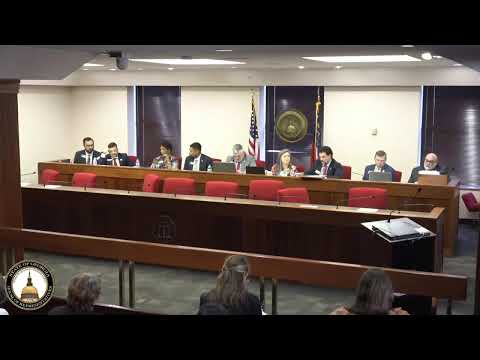
Chairman Jones introduced House Bill 414 on behalf of the Governmental Affairs Subcommittee on State and Local Government, asking the panel to authorize the Georgia Ethics Commission to compel nonresidents to produce documents related to state elections.
The bill, as presented by Chairman Jones and with Executive Director David Amati of the Georgia Ethics Commission at the podium, would allow the commission to request information from individuals domiciled outside Georgia who participate in Georgia elections. David Amati told the committee that out‑of‑state consultants and vendors who run election advertising or related activity have, in prior cycles, been beyond the reach of Georgia subpoenas.
Provisions cited in the presentation would give the ethics commission enforcement powers to seek documents outside the state and allow the commission to seek a superior‑court order if a nonresident does not comply. The draft sets Fulton County as venue for enforcement when the subject is outside Georgia. The presenter also noted a typographical correction and said the committee could adopt a committee substitute in full committee the next day.
Representative Bernal pressed for concrete examples of the activity the bill targets. Executive Director Amati described “dark money” activity by groups that hire vendors outside the state to produce advertising and other electioneering; he said the measure would let a superior‑court judge order records from an out‑of‑state vendor when the records are “pertinent or necessary to further the investigation or enforcement action.”
Committee members did not vote on the measure during the hearing. Chairman Jones said the panel would hold a hearing only that day and allow a committee substitute to be introduced in full committee the following day.
The committee did not record a roll‑call vote on the measure; the hearing concluded with committee staff noting the draft amendment for spelling and the plan to continue consideration in full committee.