Polk commissioners open workshop on transportation impact fees; debate centers on warehouse rates and competitiveness
Loading...
Summary
County staff presented options to increase transportation impact fees under Florida’s “extraordinary circumstances” process. Economic‑development groups warned steep increases would make Polk County less competitive for warehouses and industrial employers; staff described technical options including a tractor‑trailer ‘blockage’ adjustment and trip‑
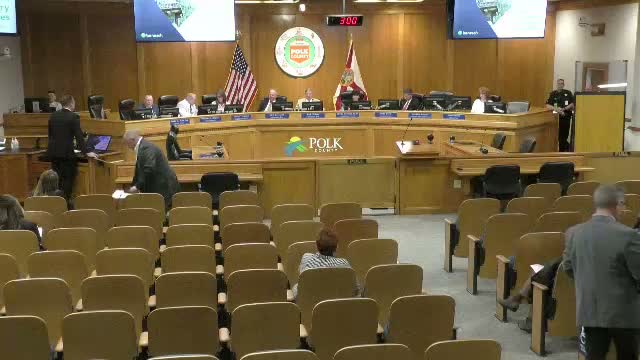
Polk County commissioners held the first of two scheduled workshops on Feb. 18 to consider raising transportation impact fees and whether extraordinary circumstances justify departing from Florida’s normal four‑year phase‑in rules.
Deputy County Manager John Bodie and staff described the legal framework and technical options. Under state statute, if a county does not follow the extraordinary‑circumstances process, statutory limits generally cap increases to 25% over two years and 50% over four years. Staff said a March 2023 study established a combined industrial/warehouse fee at $539 (about 84% of a $639 maximum cited in the study) and that a phased schedule implemented in January raised the overall schedule to $573. Staff presented alternative technical approaches and inputs, including different trip‑generation assumptions and a “blockage factor” intended to capture the greater roadway capacity consumed by tractor‑trailers compared with passenger vehicles.
Key technical inputs shown by staff included trip‑generation rates (examples: 1.71 trips per 1,000 sq. ft., 1.98 blended rate, 2.25 local rate) and capacity assumptions that change when the blockage factor is applied (capacity examples cited: 10,100 vs. 7,800). Staff said applying the local study’s blended trip rate (1.98) and other inputs would produce substantially higher fees for warehouse development than Polk’s present fee.
Economic and development stakeholders urged caution. Sean Malat of the Central Florida Development Council told the board a “300% increase” would drive investment away and asked for a modest adjustment if the board chose to use extraordinary circumstances. Steve Scruggs of the Lakeland Economic Development Council presented analyses showing the ad valorem and tangible property taxes that major employers generate annually; he argued those recurring tax revenues offset some infrastructure costs and warned that dramatic fee increases could reduce employment growth and have long‑term fiscal trade‑offs for the county. Scruggs also showed comparative fee tables for counties and cities Polk competes with and said some comparator counties in the consultant’s study (for example, Martin and Naples) are not appropriate direct matches.
Commissioners discussed trade‑offs. Some commissioners said the blockage factor was an important adjustment because tractor‑trailers occupy more space and create more queueing at intersections; others urged balancing competitiveness, jobs and infrastructure needs. Staff noted available impact fee funds countywide (about $61 million across funds cited by a speaker in public testimony), recent collections in the unincorporated county (about $350,000) and the city of Lakeland’s collections (about $2,000,000), and said transportation projects now on the county capital list can cost tens of millions of dollars per corridor.
Process and next steps
Staff framed the meeting as workshop No. 1 and told commissioners a second workshop is scheduled for March 4, followed by a public hearing on March 18. Because state law requires a 90‑day notice period for most impact fee adoption, staff estimated an effective date around July 1 if the board moves forward after the public hearing. Staff asked for direction about which of the technical options the board prefers so staff can prepare an ordinance for subsequent public hearings. Commissioners were reminded that adopting an extraordinary‑circumstances approach requires the affirmative votes of four commissioners.
What commissioners and stakeholders said (select quotes)
- "If extraordinary circumstances are deemed necessary to increase fees, we request that the commission consider a modest adjustment at this time." — Sean Malat, Central Florida Development Council (public comment). - "Adopting the warehouse transportation impact fee extraordinary measures proposal would place Polk County as the most expensive county in the Binesh and LADC studies and possibly the state of Florida." — Steve Scruggs, Lakeland Economic Development Council (public comment). - "The blockage factor is why we're here to begin with… if a truck 4 times the size of a car… has less impact, that started this ball rolling." — Commissioner comment during discussion.
Why it matters
Transportation impact fees are one‑time capital charges meant to pay for capacity‑related roadway improvements attributable to new development. Changes to fee methodology or rates could materially alter development economics for large warehouses and industrial users, affect where employers locate, and shift the pace and sources of funding available to address projected road capacity needs.
Next meeting
Staff will return with refined ordinance options and the board will hold a second workshop March 4 and a public hearing March 18. Staff requested direction on which technical approach (for example, whether to apply the blockage factor, which trip‑generation inputs to use, or whether to separate industrial from warehouse) the board wants staff to draft into ordinance language.