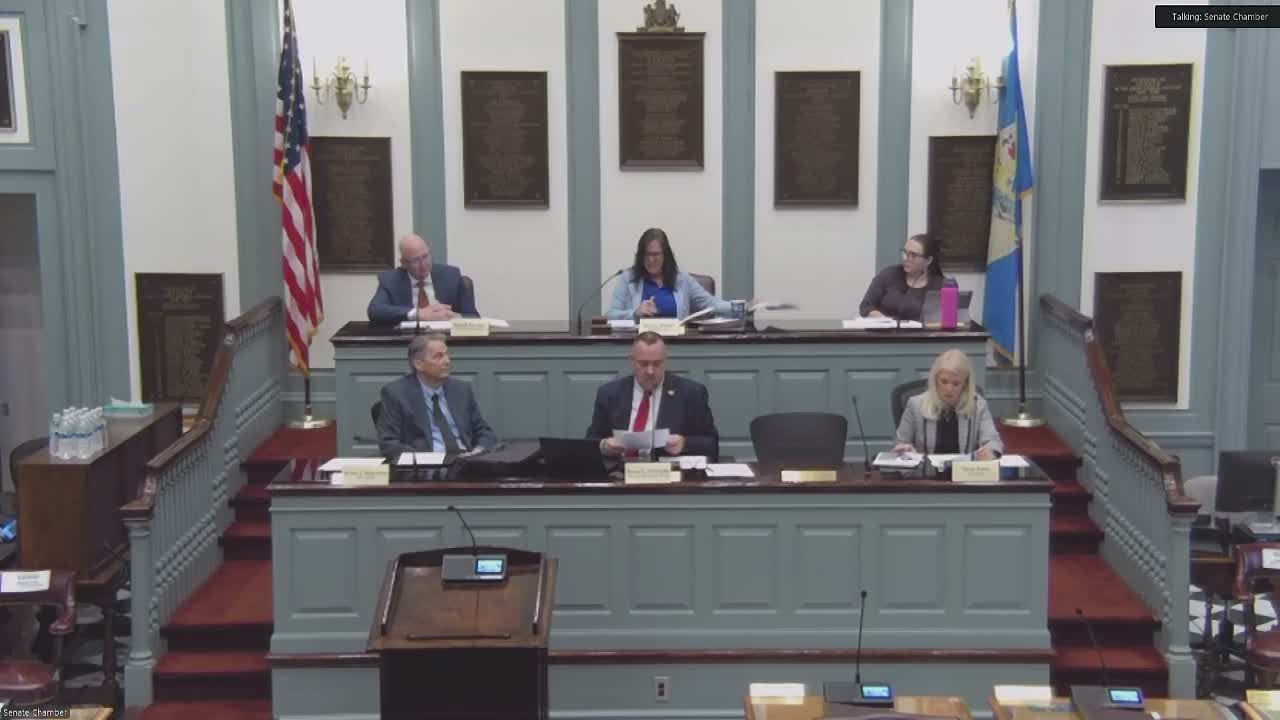
Senate committee advances discussion on SB 208 to license master’s-level psychology clinicians
Loading...
Summary
Senate oversight committee heard sponsor, regulator and public testimony on SB 208, which would create licensure and supervised-registration pathways for master’s-level psychology clinicians to expand Delaware’s mental-health workforce; no committee vote was taken and regulators will review bill language.
Dover — The Senate Legislative Oversight and Sunset Committee on Tuesday heard testimony on Senate Bill 208, which would create formal licensure and registration pathways under Chapter 35 for master’s-level psychology clinicians, including a "licensed psychology associate" and a supervised "master's-level psychological assistant." Sponsor Senator Pettyjohn told the committee the bill aims to expand the workforce while keeping oversight and disciplinary authority with the Board of Examiners of Psychologists.
"SB 208 is a targeted workforce and licensure modernization bill that expands access to evidence based mental health care while maintaining strong regulation and oversight," Senator Pettyjohn said. He told members the change is meant to increase the supply of clinicians in underserved regions and allow University of Delaware graduates and others trained in the state to practice in Delaware.
Supporters from the Delaware Psychological Association, the Department of Services for Children, Youth and Their Families and University of Delaware faculty and students said the bill would increase access to evidence-based therapies in areas with provider shortages. Douglas Tynan of the Delaware Psychological Association described the association's stance: "We do not view licensed psychology associates as competition," and argued a single board overseeing both doctoral and master’s-level practitioners would "provide better protection for the public" by setting clear training and continuing-education standards.
University of Delaware students and faculty emphasized workforce limits. "Creating a pathway for MS licensure will help address that gap in mental health care in Delaware by increasing the total number of clinicians who are trained in practices backed by scientific research," graduate student Rachel Rovere said.
Not all testimony was uniformly affirmative. Dr. Rob Mapau, a Delaware-licensed neuropsychologist, said he supports licensure but warned of potential "evaluation creep" if the bill's language allows master’s-level clinicians to perform or market broad neuropsychological assessments. "My concern is that the term cognitive will enable these clinicians to purchase and administer neuropsychological tests as cognitive tests without the extensive 2 year postdoctoral training required for clinical neuropsychologists," Mapau said, recommending the bill use the phrase "general measures of intellectual ability" and include continuing-education requirements.
Shauna Slaughter of the Division of Professional Regulation told the committee the division "was not previously aware that this bill was coming," that staff are conducting a full review of the statutory language and implementation options, and that the relevant board will take up the measure at its February meeting.
Committee members asked about similar programs in other states and where trainees would obtain qualifying education. Sponsor Pettyjohn said roughly 20 states have pathways for master's-level licensure, and cited the University of Delaware's master's program as a local training pipeline. Different witnesses cited slightly different figures when describing shortage-area counts; speakers referenced "more than 300,000" and "more than 316,000" Delawareans living in federally designated mental-health professional shortage areas.
The committee did not take a final vote on SB 208. Chair Senator Hoeffner closed the public-comment period and reminded the public that written comments may be submitted to the committee email within 24 hours to be made part of the public record. The meeting ended with procedural approval of prior meeting minutes and an adjournment motion.
Next steps: the Division of Professional Regulation will complete its language and implementation review and the Board of Examiners of Psychologists is scheduled to review the bill at its February meeting. No committee-level vote or amendment was recorded during this hearing.