Get Full Government Meeting Transcripts, Videos, & Alerts Forever!
Get email alerts on the Policy Debate topic
No spam. Unsubscribe anytime.
Work group divided over rolling back K–3 seclusion ban; parents and advocates urge stronger protections or timeline to end seclusion
Summary
Members of the seclusion working group clashed over amendment "double o7-7": proponents argued it preserves parental agency and adds safeguards for limited, consented use; opponents warned it would roll back a hard-won ban on youngest learners and highlighted disproportionate harm and traumatic misuse. No final decision was reached on changing the ban.
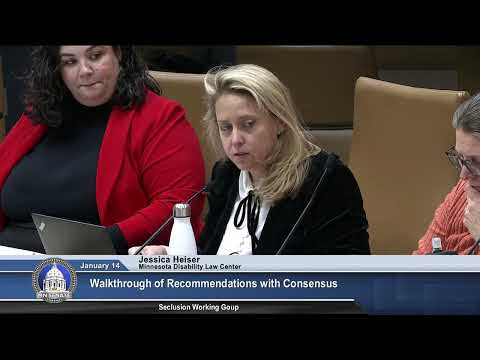
A sharp division emerged at the Jan. 14 Seclusion Working Group meeting over whether to recommend changes that would allow limited seclusion in early grades under strict parental-consent safeguards.
Senator Seaburger outlined amendment "double o7-7," which preserves a prohibition in principle but would allow seclusion in grades 1–6 if all parents or guardians provide explicit written consent separate from the IEP process, and if the Department of Education provides oral translation and other procedural safeguards. She said the amendment attempts to strike a balance between protecting children and providing a tool for some families and schools.
Opponents said the amendment would amount to a rollback of the 2023 ban on seclusion from birth through grade 3 and warned of continuing racial and disability-based disproportionality. Miss Heizer noted that 11 states have outright bans and said allowing any seclusion in grades 1–3 would be a step backward. Several members cited data they said show both large declines in seclusion and increases in staff injuries, and the group debated whether that trade-off justified preserving a limited carve-out.
Parents and advocates gave emotional testimony. Fatima Mullis described a case she said involved her client''s child being placed in a locked janitorial room without notification; she said seclusion "causes trauma" and disproportionately affects Black boys. Chair Seaburger acknowledged that those uses are unacceptable and said the recommendations are intended to prevent misuse, but several advocates said only a full K–12 ban or a definite timeline to elimination would be acceptable.
Members also debated how to set a timeline if the group recommended limited use during a phased transition. Options discussed included a firm date to ban seclusion statewide, a staged percentage reduction (for example, annual reductions toward a threshold), or requiring all setting-3 and -4 programs to implement vetted alternatives by a target date; Miss Heizer and others suggested a runway and measurable goals rather than no timeline.
Funding and implementation were recurring concerns: district representatives and administrators warned that evidence-based alternatives and equipment (trainers, mats, dedicated program resources) are costly, require ongoing training to account for staff turnover, and may be more difficult for outstate or charter districts to adopt without state funding.
The group did not resolve whether the report should recommend OO7-7, a broader K–12 ban, or a phased timeline; the chair scheduled follow-up meetings to try to narrow the options and asked staff to circulate a revised draft for the next meeting.
Ending note: the draft recommendations were approved for the report (with technical edits) but the specific question of whether to recommend changing the existing K–3 ban remained unresolved and will return to the working group in upcoming sessions.