Get Full Government Meeting Transcripts, Videos, & Alerts Forever!
Get email alerts on the Budget topic
No spam. Unsubscribe anytime.
Framingham school leaders flag $8.1 million FY27 gap as enrollment falls, warn of staff cuts
Summary
The Framingham School Committee heard a budget presentation showing a roughly $8.12 million gap for FY27 after officials reported a district enrollment decline of about 690 students (7.56%). Administrators proposed department reductions and said more cuts could affect staff if federal grants do not materialize.
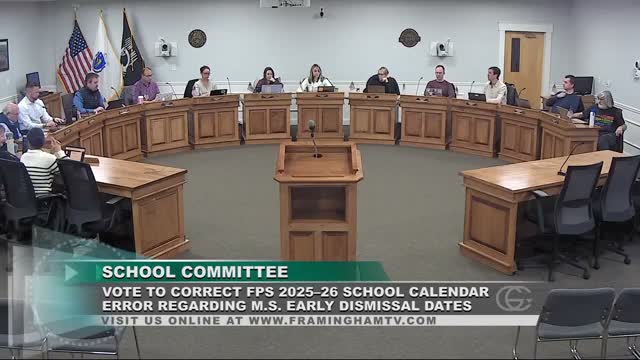
Framingham — The Framingham School Committee opened its reorganization meeting Tuesday with a budget warning: district staff told the committee the FY27 proposed budget would increase the operating plan to about $198.23 million, leaving an $8.12 million gap against the committee’s $7 million target and prompting discussion of departmental cuts and possible reductions in staffing.
Lincoln Lynch, a district administrator presenting the numbers for the administration, said, “This number here, 15,123,234 represents the FY '27 proposed budget,” and later added, “We're down 690 students. So it's a 7.56% drop.” Those enrollment figures, Lynch said, both reduce expected revenue and shift the district toward making tough choices about positions and programming.
Why it matters: the enrollment decline and projected budget shortfall translate into difficult tradeoffs. Lynch described a first-step recommendation to reduce department expense lines by $1,291,486 (roughly a 10% departmental reduction, capped at $100,000 per department) and said the remaining gap would likely require reducing positions unless additional revenue is identified.
Superintendent Dr. Tremblay framed the moment as urgent and said the district would seek to minimize impacts where possible while proceeding quickly so affected staff can plan. He told the committee the administration prefers to eliminate open positions before reducing current employees but acknowledged some layoffs may be unavoidable if the budget gap remains.
Committee members pressed administrators for specifics. Several asked how many of the approximately 100–105 FTE reductions discussed earlier are vacant and whether cuts can be targeted to open slots. Member Jennifer Moshe asked for a clearer breakdown by school and position type; Lynch answered that the district will prioritize open positions and work with principals to scale reductions relative to each school's enrollment decline.
The presentation identified principal budget drivers: salaries (78.72% of the proposed budget), $32.6 million in special tuition/transportation, $9.2 million for the in-house busing program, $4.3 million in utilities and $1.4 million for pre-K expansion. Lynch also said the administration is considering taking “some risk” on federal entitlement grants (shifting or reducing Title funding) to avoid more personnel cuts, but cautioned that would create exposure if grant amounts are reduced.
Public and union reaction: Chris Mulroney, identified as the teachers association president, urged the committee to focus on the human effects of cuts and to pursue local funding alternatives where possible. “Cuts of this magnitude will directly impact students by reducing the educators and support staff who provide instruction, intervention and essential services every day,” Mulroney said during public comment, and urged stronger local investment instead of deep staffing reductions.
Other community speakers corroborated concerns about student-facing supports, special education services and long-term effects on student performance and teacher retention. Several urged the committee to weigh options such as targeted use of reserves, midyear appropriations from the city, or a local funding increase rather than wholesale staff reductions.
Next steps: the committee opened the official FY27 public hearing and closed it after hearing public testimony. Members asked the administration to return in two weeks with clearer, school-by-school data, a list of vacant positions that could be eliminated first, and an assessment of programmatic impacts. The administration said an 80–90% draft budget book will be submitted for the committee’s February 4 vote, acknowledging it will be revised as decisions are made.
The committee did not adopt a final FY27 budget Tuesday; it requested follow-up detail and signaled strong interest in limiting harm to student-facing services as it seeks alternatives to large-scale layoffs.