Get Full Government Meeting Transcripts, Videos, & Alerts Forever!
Get email alerts on the Municipal Fees topic
No spam. Unsubscribe anytime.
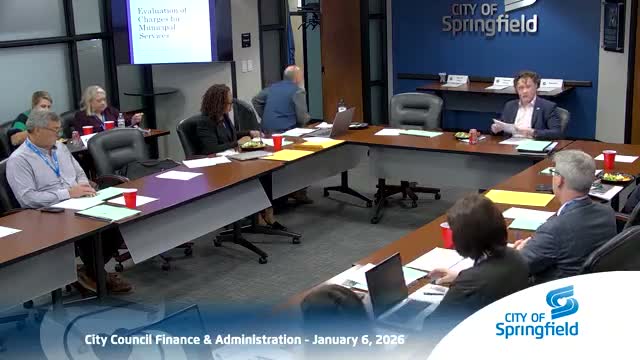
Finance committee recommends citywide fee changes, forwards study to council; staff seek two immediate fees
Summary
The Finance & Administration Committee approved the annual fee study and voted to forward the proposed increases and new fees to full council, with staff asking that a site improvement permit fee and a minimum public plan review fee be effective immediately on passage; most other changes would take effect July 1, 2026.
The Finance and Administration Committee voted Dec. 4 to recommend the city's annual fee study to full council, approving proposed adjustments that staff said would generate nearly $1.5 million in additional revenue and forwarding the package for first reading on Jan. 12 and second reading on Jan. 26.
Tammy Beaman, the city's budget coordinator, told the committee the study reviews one-third of municipal fees on a three-year rotation and applies a 2.7% CPI adjustment to the remaining fees. "Per the policy, the recommendation is to recover a 100% of the fees evaluated," Beaman said, while noting exceptions for a small set of fees such as cemetery and some health-related charges.
The study proposes changes across 185 fees, with staff identifying 35 new fees, one consolidation, eight reductions and 155 increases. Beaman said the sanitary landfill and changes to tipping fees are the single largest revenue driver in the package; staff described an overall package that would increase revenue for both general and non-general funds, and that much of the projected gain reflects landfill/tipping changes.
Key items in the committee's review included:
- Site improvement permit: Staff introduced a new optional permit to allow limited, expedited review so developers may begin site work (stormwater, limited grading, utility installation and limited footings) while full building plans are completed. Staff requested that the site improvement permit be effective immediately upon passage.
- Minimum public plan review fee: A new $1,350 minimum public plan review fee was proposed to be required upfront and credited to the public improvement fee; staff asked that this minimum also take effect immediately upon passage and noted plan review and technology fees would be nonrefundable once a project is routed for review.
- Sanitary landfill / tipping fees and waste impact: Staff recommended a 5% increase to tipping fees to cover inflationary operating costs and referenced a staff memo that includes an additional per-ton waste-impact increment staff described as $1.50 per ton; councilmembers discussed whether that increment or a broader waste-impact fee could be implemented sooner than the typical July 1 budget-cycle start and asked staff to explore options for earlier implementation.
- Enforcement and targeted fees: The study includes a reinspection fee of $84, a proposed improperly tarped/unsecured load fee (listed as $38.50), and an increase in the public health animal-control fee from $25 to $40. Staff acknowledged enforcement logistics for some fees and said they will revisit implementation methods (scale-house operators, camera evidence and enforcement protocols).
- Farmers market and limited food permit: The farmers market fee was listed as decreasing (~35%), and the package includes a limited food permit (for non-brick-and-mortar vendors) the committee noted was previously adopted by council in Nov. 2024.
During discussion, councilmembers pressed staff for clarifications about what the site improvement permit would check (zoning setbacks, footprint, site plan and stormwater), how residential permits now incorporate zoning review, and whether certain municipal-court recovery fees could be expanded beyond statutorily authorized DWI fees. Staff said they would provide written follow-up on specific criteria, historical minutes requested about the auditor transition, and a list of municipal-court fees research when available.
Staff also described costs tied to recent storm-debris operations and estimated a departmental net impact of about $3,000,000 from recent storm response, noting FEMA and other recovery processes remain in progress.
A motion by Councilman McCorden to accept the fee study as presented was seconded and carried on a roll call vote; committee members recorded their approval and the study will proceed to the full City Council for scheduled readings. Staff reiterated most fee changes would be effective July 1, 2026, except the site improvement permit and the $1,350 minimum public plan review fee, which are being requested to take effect immediately upon passage.
Votes at a glance: - Approval of Nov. 6, 2025 minutes: motion carried on roll call (recorded ayes in committee: Adebayashi, Horton, Osborn Jensen, Cosmo). - Committee vote to accept fee study and forward to council: motion carried on roll call (recorded ayes: Cosmo, Adebayashi, Horton, Jensen). - Motion to hold a closed session on privileged communications with auditors followed later in the meeting and was approved on roll call.
What happens next: The committee's recommendation will go to City Council for first reading on Jan. 12 and second reading on Jan. 26. Unless otherwise specified in the ordinance or action by council, most changes are scheduled to take effect July 1, 2026; staff requested immediate effect for the site improvement permit and the minimum public plan review fee if council adopts that language.
Quotes from the meeting: "This is the annual fee study we present to the finance administration committee," Chair Quigley said when beginning the presentation. "Per the policy, the recommendation is to recover a 100% of the fees evaluated," Beaman said during her methodology overview. "These are proposed fees. The committee does have an opportunity to make changes," Beaman added, noting the council reading dates.
Reporting note: The article uses figures and phrasing given by staff at the committee meeting. Several numeric lines in the presentation (aggregate revenue figures and some per-item totals) were presented in the meeting slide deck and read aloud; where staff's spoken totals were unclear on the record the article states staff's approximate figures and describes the fund-level allocation as reported by staff.