Get Full Government Meeting Transcripts, Videos, & Alerts Forever!
Get email alerts on the Campaign Finance topic
No spam. Unsubscribe anytime.
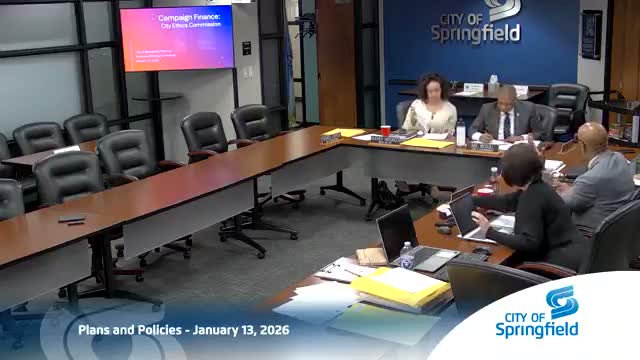
Springfield committee reviews local campaign finance ordinance, debates proposed oversight commission and in-kind rules
Summary
The Plans and Policy Committee reviewed a draft campaign finance ordinance that would subject city council candidates to local contribution limits and establish a complaints commission; members asked for clearer in-kind guidance and candidate education before voting to send the measure to full council.
The Springfield Public Plans and Policy Committee reviewed a draft campaign finance ordinance and spent most of its meeting debating the structure and administration of a proposed complaints commission and how to treat in-kind contributions.
Jordan Paul, the presenter, said the draft narrows the proposal to local council elections and campaign finance rather than creating a citywide ethics body similar to Kansas City’s model. "This has been narrowed specifically to council, specifically elections and campaign finance," Paul said, describing a commission with powers to make rules, request resources from the city manager, administer complaints, issue subpoenas and recommend referrals to prosecution or other authorities.
Under the draft, the commission would default to nine members to match a charter requirement, with three-year terms, but Paul and several members said a smaller 3–5 person body would be preferable if the charter permits. The draft includes a two-year look-back for investigatory jurisdiction, a 10-day response period for subjects of complaints and an expectation that most matters would be resolved within about 90 days.
Committee members raised confidentiality and fairness concerns. One member warned the complaint process could enable a politically-motivated "witch hunt" and asked whether complaints would remain confidential during investigation. Paul responded that the Sunshine Law applies and that criminal investigations could justify closed proceedings, but he agreed to review the applicable exceptions and report back.
A lengthy exchange focused on in-kind contributions, such as donated billboard advertising. Members asked how large in-kind gifts would be valued and counted toward the proposed $2,800 local limit and expressed concern that small, volunteer-run campaigns lack staff to track complex reporting obligations. Paul said existing state reporting would remain the primary record and that staff would cross-reference Missouri Ethics Commission disclosures to identify items that should count against local limits.
Multiple members recommended providing a plain-English candidate packet that explains reporting deadlines, valuation of in-kind donations and examples of coordinated versus independent expenditures. Paul and the chair signaled broad agreement that educational resources and clearer in-kind criteria should be added to the ordinance package before a committee vote; the chair described the draft as roughly an "85% solution" and asked staff to return with clarifications at the next meeting so the committee could consider forwarding the ordinance to the full council.
The committee did not take a formal vote on the ordinance at the meeting.