City manager summarizes outreach on convention and event center; board told to expect renderings and education plan
Loading...
Summary
City manager David Cameron reported results of a listening tour on a proposed convention and event center: about 1,233 responses, roughly 45–55% openness to a revised proposal, concerns about location, cost and accountability, and a recommendation for renderings, a reserve fund and an education plan to accompany a ballot measure.
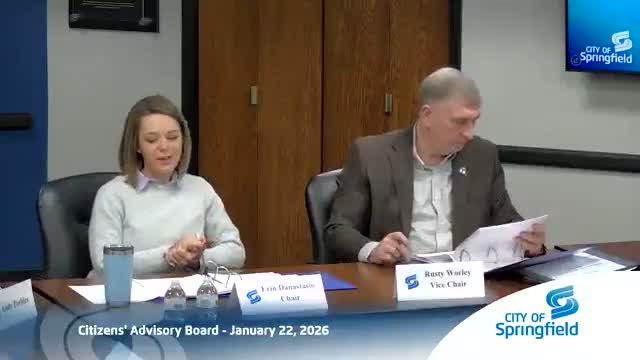
City Manager David Cameron briefed the Springfield advisory board on a months‑long listening tour about a proposed convention and event center and a revised ballot measure tied to the half‑cent tourism tax.
Cameron said staff recorded about 1,233 response instances, then used address data to distinguish local from nonlocal respondents. He said the raw feedback showed substantial opposition in many comments but that when presented with a revised proposal — including clearer location, design renderings and financing details — about 45–55% of local respondents indicated openness to the project. “You need to adjust this measure,” Cameron said, adding that people asked repeatedly to know where the project would be and how it would be paid for.
Cameron outlined the fiscal framework staff used in analysis: a 3% tourism‑tax increase tied to a pro forma 4% annual growth assumption (he said the city’s hotel/motel tax has grown about 5% annually over the past 20 years) and an underwriter projection that revenue could support roughly $145 million in proceeds. He described two cost figures for the convention center: a $175 million hard‑cap excluding some land costs and a $205 million figure that includes land acquisition if state funding is secured. Cameron said the difference reflects whether state money is available and emphasized the need to show a financing plan to qualify for state allocation that expires in June.
On accountability, Cameron said the revised ballot language the council approved includes a 35‑year sunset (30 years for debt service plus five years of cushion), and that staff plans to create a reserve funded from existing hotel/motel receipts to cover potential deltas so future general‑fund or half‑cent dollars would not be automatically tapped. He said renderings by the city’s architects are expected in early March and that staff will return to council with an education plan (previously scheduled Jan. 26, now targeted later) to be developed and presented in public. “Transparency matters,” he said, describing an outreach approach that will publish the education plan openly and invite questions.
Board members pressed on parking, safety, whether the project would take resources from police or parks, and how the project might leverage regional tourism and sports events. Cameron and staff said they will supply clearer location drawings, transit and parking concepts, and a long‑term funding strategy that pairs grants and existing tax allocations. The manager repeatedly framed his role as gathering the community’s concerns, not advocating for a specific design.
Next steps: staff will proceed with architect renderings, finalize the education plan for council review and continue community engagement ahead of any ballot submittal.