Get Full Government Meeting Transcripts, Videos, & Alerts Forever!
Get email alerts on the Land Use topic
No spam. Unsubscribe anytime.
Developer tells Scappoose council market study supports flexible commercial rezoning for Parker Quarry
Summary
Romano Capital presented a market study recommending an expanded-commercial designation for the Parker Quarry site to allow retail, housing and flex industrial uses; presenters estimated near-term demand for about 200 multifamily units and roughly 12,000 sq ft of retail absorption per year, and outlined a master-plan process expected to take about 29 months.
Romano Capital representatives told the Scappoose City Council on Dec. 15 that a market study supports rezoning the Parker Quarry site to an expanded-commercial designation that would give the city maximum flexibility to deliver retail, housing and supporting services as the community grows.
Greg McGreevy, vice president for development at Romano Capital, said the study found Scappoose's market is undersupplied in retail and multifamily housing. "On the low end, you could absorb somewhere around 12,000 square foot of retail on an annual basis over the next 10 years," McGreevy said, and he estimated immediate multifamily demand "somewhere around 200 units" with a site capacity of roughly "2 to 300 units max in the next 5 to 10 years." He added, "This is not a site that you're gonna see thousands of units on."
Stacy Shields, Romano's director of entitlements, outlined a multi-stage master-plan process that she said would produce a schematic master plan, financial modeling and formal city review including annexation and a developer's agreement. "Do you see 29 months to get through this entire process? That would be May 2028," Shields said, citing the team's schedule for initial approvals and phasing. She and McGreevy emphasized the need for a collaborative master-plan process with public open houses and repeated staff check-ins.
City staff noted zoning implications and legal limits. Laurie (staff member) told the council the expanded-commercial zone would typically allow mixed-use multifamily and live-work townhomes but cannot prohibit state-permitted income-restricted housing. "The state says that would be permitted regardless," Laurie said, explaining the city's limited ability to bar affordable developments if state law allows them. Staff also reported an attorney's preference against rezoning solely for one parcel or owner and recommended careful drafting of covenants or agreements.
Councilors and commissioners asked about alternatives to a full rezoning, including a phased rezone that would bring parcels into new zones over time. Some members raised a specific infrastructure concern: the location of utilities favors rezoning certain parcels first, but staff warned the southern parcel's utilities and desired land-use grouping could make a phased approach difficult. McGreevy said the site's combination of utilities, transportation access and annexation potential makes it "an uncommon" opportunity and argued that an expanded-commercial designation provides the greatest long-term flexibility to pair housing, retail and adjunct industrial uses.
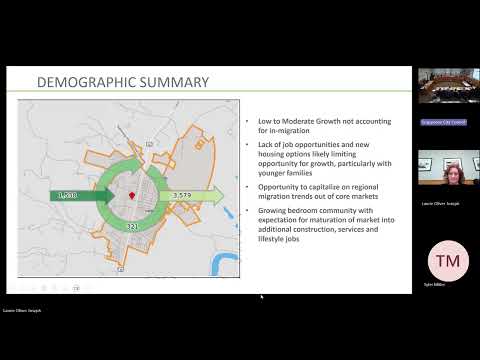
The presenters also highlighted broader market context: Scappoose has a low multifamily vacancy (under 4 percent), modest population growth since 2020, and a significant supply of raw industrial land in the county (roughly 500 acres) that could be recruited for jobs if the city creates the right mix of housing and services.
The council did not take formal action during the work session. Staff and council agreed to proceed to the regular meeting to hear two public comments and then briefly reopen the work session to discuss those comments and any planning commission input before deciding next steps.