Get Full Government Meeting Transcripts, Videos, & Alerts Forever!
Get email alerts on the Land Use topic
No spam. Unsubscribe anytime.
Monmouth council initiates expedited UGB land exchange authorized by House Bill 2647
Summary
The Monmouth City Council voted 6-0 to initiate Legislative Amendment 25-02, the local process to carry out a state-authorized urban growth boundary (UGB) land exchange under House Bill 2647. The swap would remove up to 90 acres constrained by wetlands and bring roughly 75 net acres of buildable land into the UGB, with public hearings and county concurrence to follow.
The Monmouth City Council voted unanimously on Nov. 4 to begin the local process required to complete an urban growth boundary (UGB) land exchange that the Oregon Legislature authorized this year.
Suzanne Duffner, Monmouth’s community and economic development director, told the council the February legislative action — House Bill 2647 — allows Monmouth to pursue an expedited land swap aimed at creating more developable land inside the city’s UGB. By removing up to 90 acres dominated by floodplain and wetlands and bringing in about 75 net acres of less-constrained land, Duffner said the exchange would yield more productive acreage for housing without expanding the total buildable footprint beyond what is practical after removing constrained lands.
The motion before the council was limited to initiating Legislative Amendment 25‑02, a Type 4 legislative amendment under city code that will change the comprehensive plan map designations for the parcels that would leave and enter the UGB. Duffner said the process will include notifying affected property owners and the state, holding a public hearing before the planning commission and then a public hearing before the council; Polk County must also approve concurrent changes to county maps.
Councilors praised the effort as an important, and relatively rare, tool for Monmouth. “This is something my understanding has only happened maybe a couple times in state history,” Councilor Lopez said, thanking staff and representatives who worked on the bill. Duffner said her office had collaborated with the governor’s office and housing partners, and that the former city attorney helped draft the legislation.
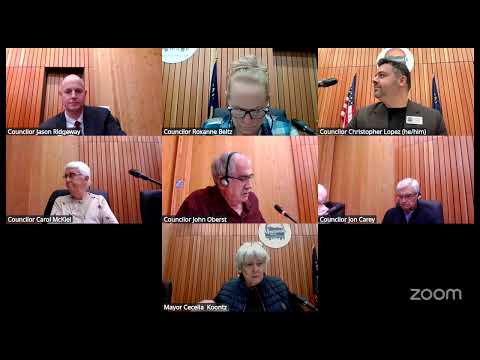
Phyllis Bowman, the city recorder, called the roll on the motion to initiate the amendment. The council recorded the motion as passed 6–0 (Ridgeway Aye; Oberst Yes; McKeel Yes; Lopez Aye; Carey Aye; Belts Yes).
Duffner cautioned that the council’s initiation decision is only the first step: detailed inventories of wetlands and floodplain are still required, and the council will later consider an ordinance and a formal adoption decision after planning commission review and public hearings. She said the bill becomes effective Jan. 1 and staff expects the ordinance and adoption hearing to take place in early January.
What happens next: Staff will notify property owners and the state, complete required mapping and GIS work (assisted by the regional COG), schedule the planning commission hearing and then a council adoption hearing. The council’s initiation vote does not authorize property changes or annexation; those additional legal and map adjustments will come later.