Get Full Government Meeting Transcripts, Videos, & Alerts Forever!
Get email alerts on the Guaranteed Income topic
No spam. Unsubscribe anytime.
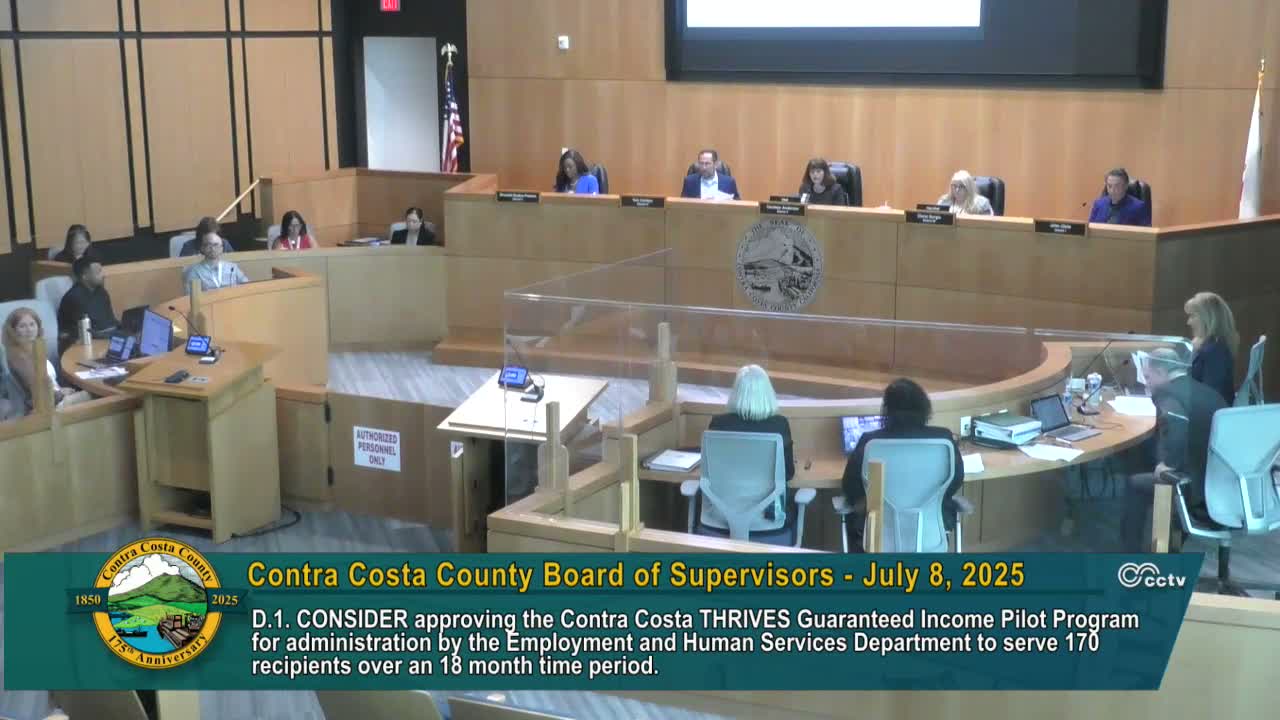
Board approves Contra Costa Thrives guaranteed‑income pilot, funds evaluation
Summary
The Contra Costa Board of Supervisors approved an EHSD‑administered guaranteed‑income pilot (Contra Costa Thrives) that will deliver $18,000 per household to ~178 participants drawn from county program caseloads and fund a five‑year evaluation. The vote was 5–0.
The Contra Costa County Board of Supervisors on July 8 approved a county‑administered guaranteed‑income pilot called Contra Costa Thrives, directing the Employment and Human Services Department to administer monthly cash payments to a randomized group of county program participants and invest in a multi‑year evaluation.
Marla Stewart, director of EHSD, told the board the pilot will use $3,250,000 in Measure X funds and $1,000,000 in AB 109 funds already allocated by the board. Each participant will receive a total of $18,000 distributed over either 12 or 18 months; participants will choose among three payment options intended to reduce the risk of a sudden “cliff” when payments end. The program targets four populations: youth transitioning from foster care, families with young children, people reentering the community after incarceration, and housing‑insecure older adults. Stewart said the county expects to invite referrals from caseworkers, randomize consenting participants through UC Davis, and serve roughly 178 households with a control group for evaluation.
EHSD recommended a five‑year longitudinal evaluation to measure economic stability and recidivism outcomes; Stewart said the evaluation contract request includes $615,111 (about 14% of the pilot budget), of which roughly $160,000 would cover participant incentives for follow‑up surveys. Supervisors pressed staff about evaluation cost and length, the tradeoff between evaluation and serving more people, and whether the county could instead contract a community‑based organization to administer the pilot. EHSD responded that selecting participants from existing county programs reduces administrative overhead and ensures case‑management supports are available during the pilot, but said the office would implement board direction if supervisors prefer a different design.
Public commenters — including members of the Contra Costa Guaranteed Income Coalition, community‑based organizations and providers — urged broader eligibility that would include residents not currently enrolled in county programs and urged greater community co‑design and use of local CBOs for outreach and administration. Several speakers also argued for less expensive evaluation designs and for guaranteeing access to undocumented residents. EHSD answered that the county will not require citizenship documentation for programs such as independent living, probation and adult protective services and that program rules for specific funding streams (for example, AB 109) still constrain how funds may be used.
Supervisor Ken Carlson moved to approve EHSD’s recommendation; after further discussion of evaluation options and possible work groups to reduce evaluation costs while preserving rigor, the board approved the recommendation unanimously. Stewart said staff will finalize operational plans over the coming months, contract vendors for payment disbursement and orientation, select participants by December and plan to issue first payments on Jan. 15, 2026. A final longitudinal report is planned for 2033.
The board’s action funds the pilot as a county‑administered test rather than a community‑run model; supervisors and public commenters urged continued discussions about contractor roles, evaluation scope, and whether future rounds should include participants not already engaged in county programs.