County denies Kensington appeal, requires immediate vegetative screening and winter 'durable decorations' to protect neighbor privacy
Loading...
Summary
The Board of Supervisors denied an appeal of a Planning Commission approval for a 568‑sq‑ft rooftop deck at 2 Highland Boulevard in Kensington but added and clarified screening conditions requiring evergreen vegetative screening providing immediate coverage prior to a building permit and enforcement provisions. The board voted 4–0 after hours of testimony and debate.
The Contra Costa County Board of Supervisors on March 25 denied an appeal of the county Planning Commission’s approval for a rooftop deck and Juliet balcony at 2 Highland Boulevard in Kensington, but modified the project’s conditions of approval to strengthen privacy protections for adjacent neighbors.
Staff planner Dulce Rekmeier Walton and Deputy Director Ruben Hernandez summarized the project as an exterior change to an existing single‑family home that includes a 568 square‑foot rooftop deck and a Juliet balcony. Planning staff told the board the commission had modified the approval to require vegetative screening that extends at least 6 feet above the existing fence line and 8 feet wide in the affected area, with landscaping plans due at least 30 days before issuance of a building permit and inspections to verify installation and maintenance.
Neighbors Heman Patel and Aditi Shastri, who appealed the decision, said the planning commission’s oral discussion had been inconsistent with the written conditions and that the county’s proposed remedy—planting a single tree 2–3 feet wide that could take years to reach the specified dimensions—would leave them without privacy during construction and for an extended period afterward. Patel asked the board to deny the deck portion of the application or, at minimum, require a permanent, enforceable screen 6 feet above the existing fence and 12 feet wide, and to tighten enforcement so reductions in screening could not be trimmed back by 25% without triggering sanctions.
Property owner Kane Barclay said the unpermitted roof deck had existed when he purchased the home, that the design approved by the Planning Commission and KAMAC balanced views and privacy, and that the combination of the approved 8‑foot screening and existing vegetation (a mature maple tree) would provide adequate protection. He offered temporary seasonal screening measures while new plants mature.
Supervisor John Gioia, whose district includes Kensington, proposed clearer, written language to replace ambiguous statements made at the Planning Commission. The board’s amendments require evergreen, drought‑tolerant vegetative screening installed and providing the agreed privacy protection prior to issuance of a building permit; maintenance obligations for existing vegetation (including the maple tree); and a requirement that the property owner make a good‑faith effort to mitigate winter leaf loss through durable decorations or similar durable means to preserve winter privacy. Staff said landscaping plans will be reviewed and the county’s code enforcement process and fines ($100 first day, $200 next day, up to $500 per day thereafter) apply to violations of permit conditions.
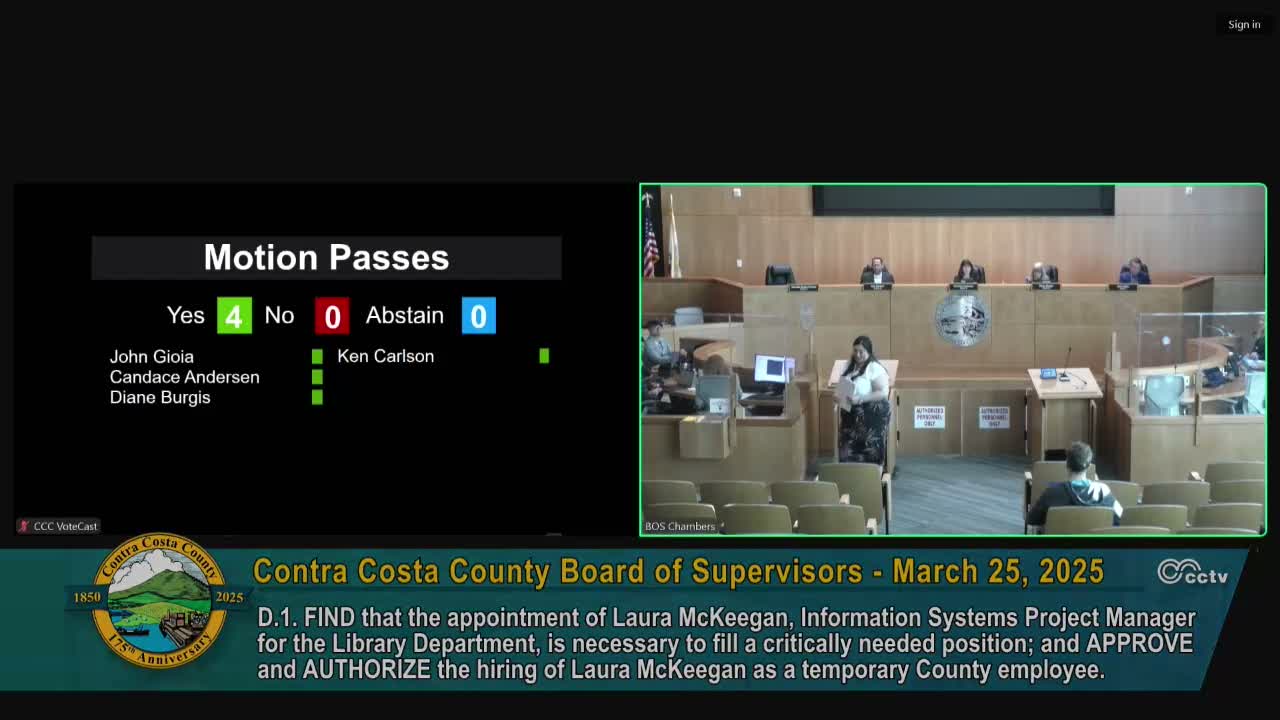
Supervisor Gioia moved to deny the appeal and adopt the Planning Commission decision as modified; Supervisor Ken Carlson seconded. The motion passed 4–0. The board directed staff to reflect the clarified, enforceable screening language in the final board order and to return to the record with contract/inspection steps as needed.
What’s next: The board’s action affirms the Planning Commission’s approval with clarified, enforceable conditions. The project will not proceed to building permit issuance until the County’s Community Development Department approves landscaping plans that demonstrate compliance with the screening requirement and inspects installation.