Get Full Government Meeting Transcripts, Videos, & Alerts Forever!
Get email alerts on the Adult Entertainment Regulation topic
No spam. Unsubscribe anytime.
Pierce County updates adult-entertainment rules to align with new state safeguards; council adds local enforcement trigger
Summary
The Pierce County Council updated local adult-entertainment licensing to conform to state law (SB 6105) while adopting a local backstop allowing the auditor to impose temporary separation and visibility requirements if an establishment accumulates repeated violations; the ordinance passed 4–3 after amendments and public testimony.
Pierce County on Tuesday amended its local adult‑entertainment code to align county licensing and safety rules with a statewide framework enacted in 2024, while building in a local enforcement mechanism tied to repeated violations.
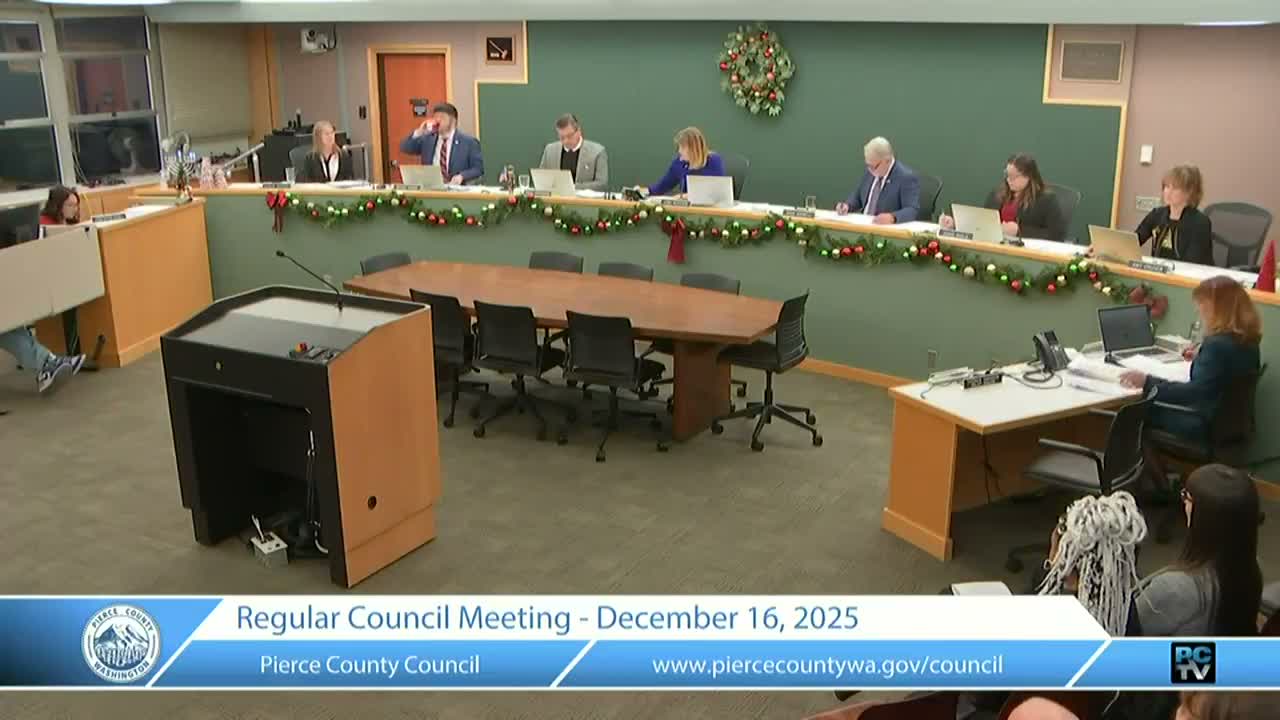
The council adopted ordinance O2025‑573s after an extended hearing that included staff briefings, industry testimony and two rounds of amendments. The final measure updates definitions and licensing periods, permits electronic gratuities, removes some locally prescriptive rules now covered by state regulators, and embeds an auditor‑triggered enforcement tool: if an establishment records four or more violations of the county’s touching‑prohibition provisions in a six‑month period, the auditor may temporarily require a four‑foot separation between stage and patrons and unobscured visibility into performance areas.
Julie Murray, counsel to the executive, told the council the state law created “a very strong comprehensive framework governing worker safety, training requirements, panic buttons, staffing levels, workplace conduct, and labor protections,” and said the county changes folded in auditor recommendations and executive additions. “These entertainers are safer now with these state laws,” Murray said during the staff presentation.
Industry representatives and performers urged the council to remove local restrictions that they said were stigmatizing and less protective than state regulation. Winter Fink, an operator of venues that include Dreamgirls Tacoma and Foxes, said the ordinance had been vetted by the county auditor and others and asked the council to modernize local rules. Performer Bam, a dancer and industry advocate, said training, regulation and clear safety practices — not legacy distance rules — were what kept workers safe.
Council debate focused on the balance between consistency with state law and local safety concerns. Vice Chair Herrera proposed reinstating a strict separation and visibility requirement (reducing 10 feet to a 4‑foot standard); council members proposed and then defeated an amendment raising that floor to five feet. The adopted compromise (Amendment 1A) allows the auditor to impose a temporary 4‑foot separation and require unobscured visibility at an establishment only after documented, repeated violations of the county’s touching prohibitions.
Public commenters included an individual who identified as a survivor of trafficking and other speakers who urged both vigilance and meaningful enforcement. The ordinance passed on a 4–3 roll‑call vote.
The ordinance’s practical effect, supporters said, is to bring local code into parity with state protections (including mandatory panic buttons and industry‑specific safety and training standards enforced by Labor & Industries and other state agencies) while preserving a narrowly tailored local enforcement option where patterns of unlawful touching are documented.
Council documents show the changes were informed by a 2024 auditor review and subsequent executive office adjustments; the council substituted amendments to clarify enforcement thresholds and preserve local authority to respond to repeated violations. The ordinance takes effect as stated in the text (as adopted).