Get Full Government Meeting Transcripts, Videos, & Alerts Forever!
Get email alerts on the School Impact Fees topic
No spam. Unsubscribe anytime.
Pierce County council raises 2026 school impact fees modestly, directs staff to revisit formula for 2027
Summary
The Pierce County Council on Dec. 2 adopted an ordinance adjusting school impact fees for 2026 — raising the county's maximum fee obligation to $4,695 for single‑family and $2,490 for multifamily units — and asked staff to return with recommendations to align calculations with forthcoming state rule changes.
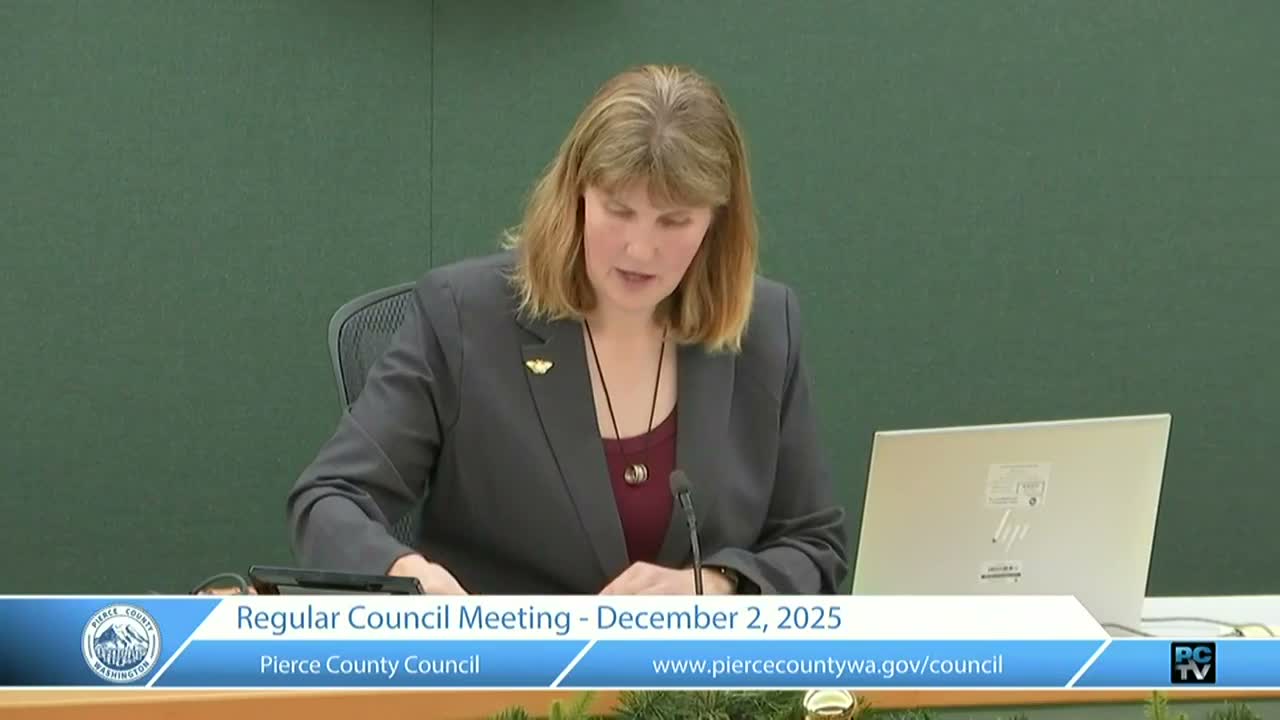
The Pierce County Council adopted an ordinance Dec. 2 updating the county’s school impact fee schedule for 2026, approving modest increases intended to reflect rising construction costs. The ordinance, Proposal O2025‑555S, adjusts the county’s maximum fee obligation to $4,695 for single‑family dwellings and $2,490 for multifamily units, increases of roughly $100 and $55 respectively from 2025.
County staff described the fee as a one‑time charge on new developments to offset capital needs created by growth. Mr. Swanson, who briefed the council, said the county computes a maximum fee obligation (MFO) using a 20‑city average construction cost index published by Engineering News‑Record; the MFO is rounded to the nearest $5 increment and the developer is charged the lower of the district’s calculated fee or the county MFO. Swanson noted an equity analysis in the council packet and said the changes produce “no or de minimis fiscal impact” to county operations because collected fees are transferred to the district where they were generated.
Council member Denson thanked school districts, the Master Builders Association and staff for a year‑long collaborative process and called the increase “very reasonable.” She and other council members said additional technical issues remain for future cycles — for example whether to calculate fees by square footage or number of bedrooms — and the council directed staff to return with recommended ordinance language for the 2027 cycle to implement state regulatory changes linked in the packet (the briefing referenced compliance with Senate bill language affecting impact‑fee calculations).
The council voted by roll call with seven ayes and zero no votes; the ordinance was adopted. The ordinance takes effect as stated in the enacted text and staff will prepare the recommended changes for the 2027 fee cycle.
What’s next: staff will return with detailed ordinance language and calculations ahead of the 2027 cycle to align the county schedule with state rule changes and the council’s policy direction.