Get Full Government Meeting Transcripts, Videos, & Alerts Forever!
Get email alerts on the Budget topic
No spam. Unsubscribe anytime.
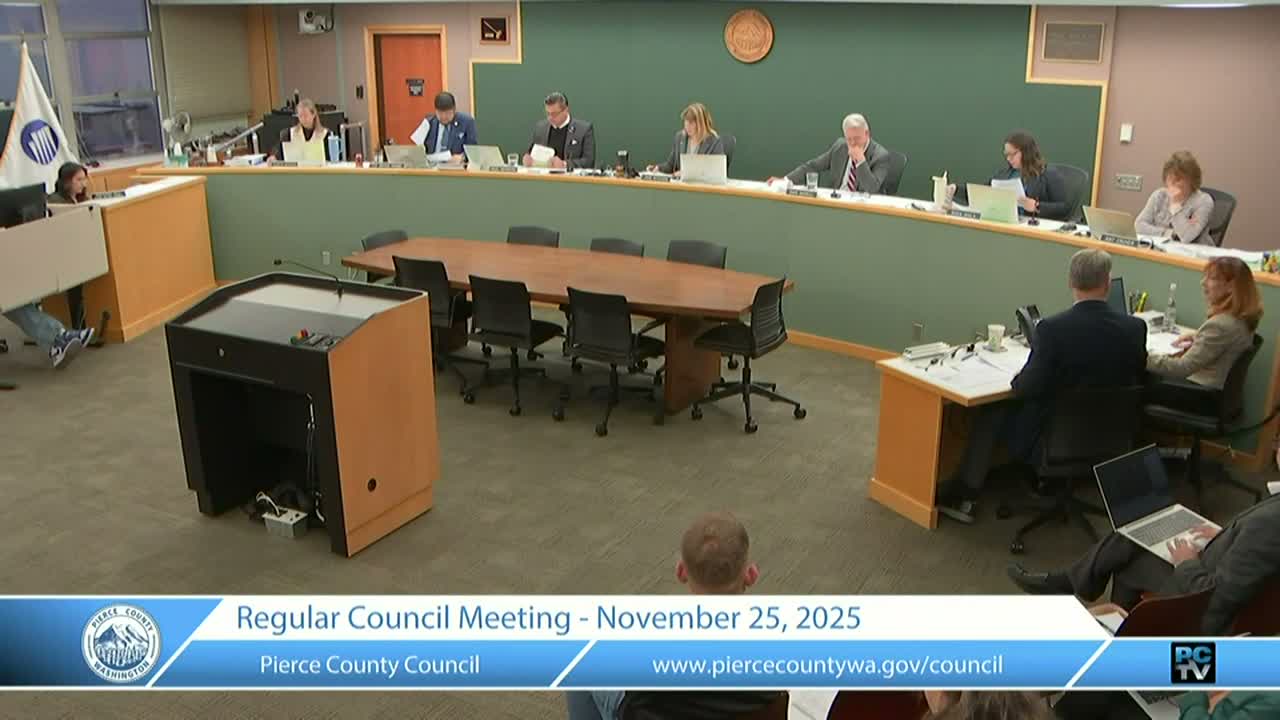
Pierce County Council adopts 2026–27 biennial budget after heated debate over sheriff staffing
Summary
The Pierce County Council voted 4–3 on Nov. 25 to adopt the amended biennial budget for fiscal years 2026–27, a package that increases public‑safety spending but drew sustained public criticism over deputy staffing levels and bargaining uncertainties.
The Pierce County Council voted 4–3 on Nov. 25 to adopt O2025‑562S3, the county's biennial budget for fiscal years 2026–27, after hours of debate and a public hearing dominated by calls for more funding to retain and recruit sheriff’s deputies.
Council staff summarized the spending plan before the vote: proposed general‑fund expenditures total $967,264,000, with the largest amounts directed to public safety (sheriff law enforcement roughly $242 million; sheriff corrections about $164 million), the prosecuting attorney (~$94 million) and juvenile court (about $55 million). Capital projects funded through the plan amount to roughly $353 million over the two‑year period; enterprise operations such as the sewer utility are budgeted separately and total several hundred million dollars.
During public comment, more than a dozen residents, retired law‑enforcement officers and community leaders urged the council to allocate additional money now for retention bonuses and incentives. Eric Lundberg, a pastor and longtime Pierce County resident, told the council: “Please set aside your differences and bias and support our sheriff that was elected by the vote of the people.” Several speakers cited the county’s low deputy‑to‑resident ratio and said vacancies are creating response gaps in rural and island communities.
Council members who opposed the final budget framed their votes around process and timing rather than the budget’s content. One member said they opposed the ordinance because key collective‑bargaining outcomes with the Sheriff’s Guild were unresolved; council members explained that the county cannot ratify contract costs until arbitration and negotiation conclude. Vice Chair and other supporters said the budget preserves the county’s core services and leaves contingency funds available to respond after bargaining is settled.
The ordinance passed after a final roll call that recorded four ayes and three nays. Council leaders and the finance director, Julie Demuth, said the budget both increases public‑safety funding compared with the previous biennium and includes provisos and reporting requirements intended to let the council respond quickly if contract terms require mid‑biennium adjustments.
Key provisions and next steps include an allocation of roughly $30 million in current ARPA appropriations in the budget package; council amendments that created provisos for quarterly reporting and special one‑time hires; and direction to staff to implement the adopted capital facilities plan. The executive has until Dec. 1 under county rules to sign or veto the ordinance; council members said they will meet with executive staff to ensure implementation proceeds and to respond to any outcomes from bargaining.
The council’s vote brings the budget into force for the new fiscal year beginning Jan. 1, 2026, pending executive action. Councilmembers and staff said they expect additional follow‑up briefings and, if collective bargaining produces wage changes, the council will consider the necessary budget amendments to fund them.