Get Full Government Meeting Transcripts, Videos, & Alerts Forever!
Get email alerts on the Personnel Policy topic
No spam. Unsubscribe anytime.
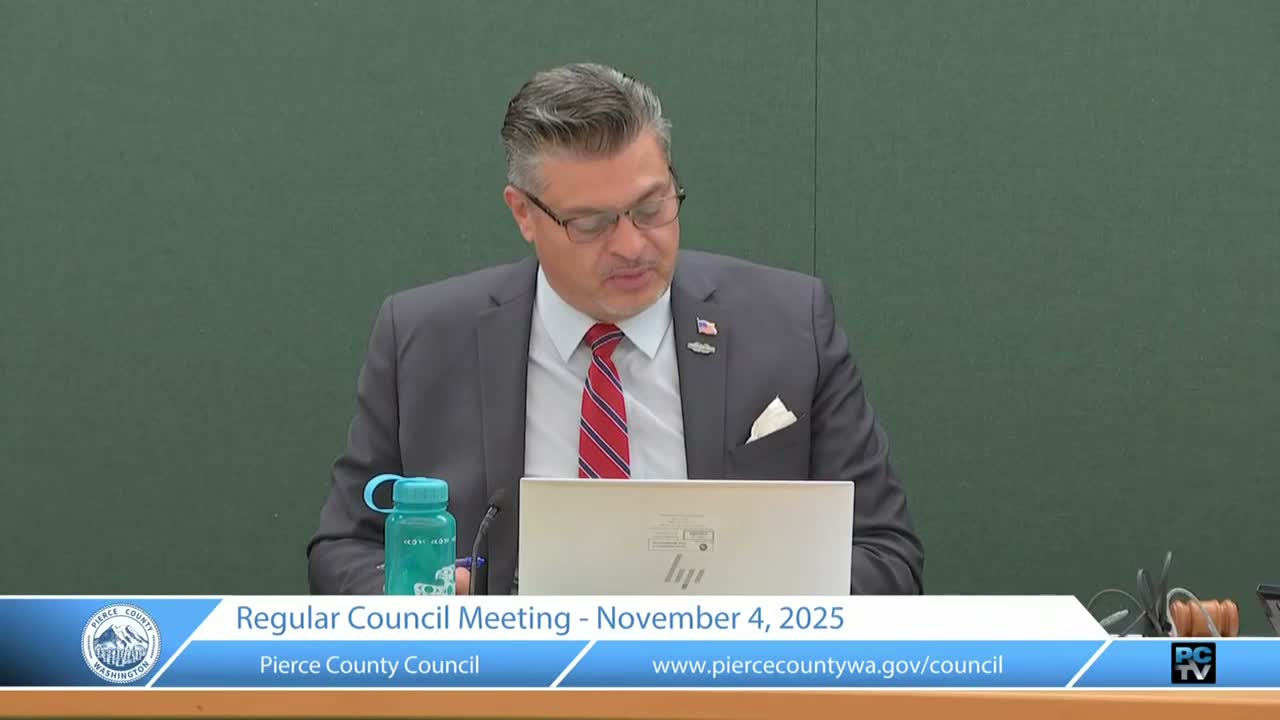
Pierce County adopts personnel-code overhaul after failed amendments and public comment
Summary
After three proposed council amendments failed, the Pierce County Council adopted Ordinance O2025-539 revising Title 3 personnel provisions to add chapters on workplace conduct and discipline, expand sick-leave uses (including immigration proceedings), and update definitions; council vote was 6–1.
Pierce County’s council adopted Ordinance O2025-539 on Nov. 4, 2025, updating portions of Title 3 of the Pierce County Code covering personnel definitions, workplace conduct, discipline, domestic-violence leave, and sick-leave uses. The clerk recorded six ayes and one nay; Council member Morel voted no.
Chief counsel Susan Long summarized the ordinance as a package of changes that repeal the existing chapter on diversity, equity and inclusion and replace it with a new chapter titled "welcoming workplace culture and conduct," add a new chapter on discipline, revise multiple definitions (including moving or consolidating definitions), shorten the maximum extra-hire term from six months to five months, and expand permissible uses of sick leave. The sick-leave expansion includes uses when a workplace or a child’s care is closed for health reasons and to prepare for or attend immigration proceedings for an employee or a family member, language staff said is consistent with Chapter 49.76 of state law.
HR Director Robin Vasquez described the ordinance as the first phase of administrative updates to incorporate statutory changes from the 2025 legislative session and to improve clarity and accessibility of county policy. Vasquez said the county already provides religious-accommodation processes and that some proposed conscience protections duplicate existing practices; she said the ordinance aims to clarify how employees can find and use existing rights.
Council members debated three council-sponsored amendments. Amendment 1 would have added a prohibition on “licentious conduct”; Amendment 2 would have added a one-paragraph “right of conscience”; Amendment 3 would have recentered and tightened language, moving definitions to a central section and removing DEI-specific wording. Each amendment was moved, deliberated and defeated on roll calls (each failed by 3–4).
Public comment split: speakers including Austin McDonald and Janice Clark urged the council to preserve inclusive approaches and equity; Heather Benedick raised an unresolved allegation that a Pierce County commissioner and staff deleted a court order related to her mother’s probate and asked the council to investigate. The allegations were presented as a citizen complaint and were not adjudicated during the meeting.
The ordinance passed 6–1. Staff noted an equity note and a fiscal note in the packet and indicated no immediate fiscal impact was expected. The council chair thanked staff and indicated further administrative guideline updates could follow.