Get Full Government Meeting Transcripts, Videos, & Alerts Forever!
Get email alerts on the Hr1 Impacts Medicaid topic
No spam. Unsubscribe anytime.
Lawmakers and hospital leaders warn HR 1 changes risk coverage losses and drive rural hospitals deeper into financial strain
Summary
Senators, the Minnesota Hospital Association and front‑line workers told a subcommittee that federal budget provisions (HR 1) and the loss of ACA premium supports could cause Medicaid coverage losses, higher uncompensated care and strained rural hospital operations, while residents described immediate personal impacts.
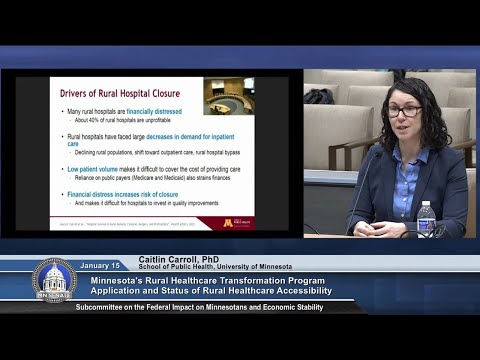
Lawmakers and health sector witnesses told the Senate Select Subcommittee on Jan. 15 that recent federal budget and policy changes could increase uninsured rates and uncompensated care in Minnesota, placing additional strain on rural hospitals that already operate with thin margins.
Joe Schindler, vice president of finance policy for the Minnesota Hospital Association, said the nonprofit association was "cautiously optimistic" about RHTP funds but warned the award cannot replace losses tied to federal policy changes. Citing a Department of Human Services estimate, Schindler said, "a 140,000 Minnesotans, could lose their Medicaid coverage" because of administrative barriers and work requirements in federal changes, and MHA estimates those losses could translate into roughly $270,000,000 in additional charity care borne by hospitals.
Hospital leaders and the association highlighted several pressures: reductions in federal Medicaid spending projections from HR 1, uncertainty about longstanding programs such as 340B pharmacy pricing, increases in private‑market costs that could push people into high‑deductible plans, and immediate local service contractions in some communities.
Senator Rasmussen pressed hospital witnesses on consolidation, facility fees and executive pay as drivers of public frustration, citing media reports of high nonprofit executive compensation. Michelle Benson of MHA responded that hospitals must serve everyone who arrives at their doors and recommended a broader conversation about hospital financing while pointing to cost‑shift dynamics between public and private payers.
Residents and front‑line workers gave personal testimony about how coverage and access changes have affected families. Dawn Burnpin, president of AFSCME Local 6519 and a behavioral‑health worker, said uninsured and publicly insured patients form a large share of those she treats and urged action: "These are actual people," she said, describing reliance on Medicaid and ACA supports. Chantelle Oxley, a home‑health worker, said loss of ACA premium supports derailed her family's plans and forced her to forgo law school because coverage became unaffordable.
Why it matters: witnesses and lawmakers tied projected coverage losses to operational and financial strain for rural hospitals and to concrete access problems for patients who may have to travel farther for care or delay needed services.
Proposed responses discussed in the hearing included legislative stabilization funds, targeted short‑term infusions, and reconsideration of how the state's RHTP grantmaking could be structured to provide more upfront cash for providers with constrained liquidity. MHA suggested a state stabilization pool to complement RHTP, while committee members urged quick, practical approaches given a compressed legislative calendar.
Provenance: DHS estimates and MHA figures were cited in testimony beginning at SEG 1386 and the resident testimonies appear throughout the Zoom testimony block (SEG 2041–SEG 2550).