Get Full Government Meeting Transcripts, Videos, & Alerts Forever!
Get email alerts on the Childcare Policy topic
No spam. Unsubscribe anytime.
Committee hears broad support for package to boost infant/toddler subsidies and make employment award permanent
Summary
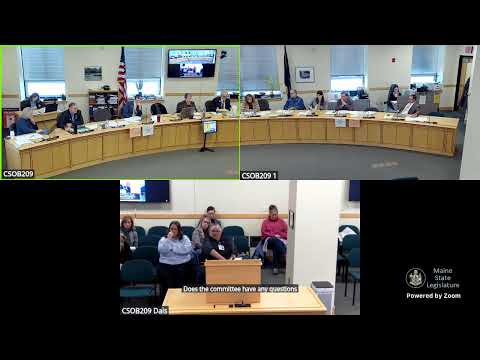
During a public hearing the committee heard extensive testimony supporting LD 1414 (raise CCAP infant/toddler rate from 10% to 20% and create planning grants for nontraditional hours) and LD 2066 (make Child Care Employment Award permanent); providers and advocates stressed workforce, equity, and economic benefits.
The Health and Human Services Committee heard dozens of providers, parents and advocacy groups urging lawmakers to approve a pair of bills aimed at stabilizing Maine’s child care system: LD 1414, which would increase the Child Care Affordability Program (CCAP) subsidy bump for infant and toddler care from 10% to 20% and provide planning grants to support nontraditional hours, and LD 2066, which would make the Child Care Employment Award a permanent program.
Senate President Maddie Daughtry, sponsor of LD 1414, described the proposal as the result of a statewide listening tour. Daughtry said the CCAP rate bump targets the highest‑cost part of the system — infant and toddler care — where staffing ratios are lower (for example, licensing ratios include 1:4 for infants) and operating costs are comparatively higher. She said the bill aims to make providing infant and toddler care more financially viable and to fund grants that help providers analyze and plan service models for off‑hours care.
Witnesses from the Maine People’s Alliance, the YMCA Alliance of Northern New England, Maine AFL‑CIO, Maine Association for the Education of Young Children, ReadyNation, and many individual program directors and owners testified in strong support. Testimony highlighted long wait lists for infant slots, market‑rate analyses showing a large gap between CCAP reimbursement and true cost in some regions (an example cited: an Aroostook County infant market rate that would demand several hundred dollars per week), and the fragility of a workforce paid wages that often make it impossible for educators to afford child care for their own children.
Senator Ingwersen introduced LD 2066, the Child Care Employment Award, explaining the pilot has supported hundreds of children and hundreds of educators but now faces wait lists and capacity limits. Supporters said the award fills important gaps left by CCAP by covering co‑payments and enabling childcare workers to remain in the field; multiple providers reported that the award allowed them to hire staff, open classrooms and retain employees who otherwise would have left.
Providers also raised operational challenges: steep insurance cost increases, narrow operating margins (many centers reported single‑digit profit margins), and that federal funds (child care block grants) are flat‑funded in the near term, which limits the reach of subsidy expansions without state investments. Several witnesses noted the interaction between public pre‑K expansion and private childcare finances, urging coordinated planning so community providers are not inadvertently forced out of the market.
Several providers and coalition representatives asked the committee to pair CCAP rate increases with wage supplements, continued funding for the Employment Award, and targeted grants to support nontraditional hours. The committee closed the public hearing and will consider work‑session language and funding options in upcoming meetings.