Get Full Government Meeting Transcripts, Videos, & Alerts Forever!
Get email alerts on the Climate Policy topic
No spam. Unsubscribe anytime.
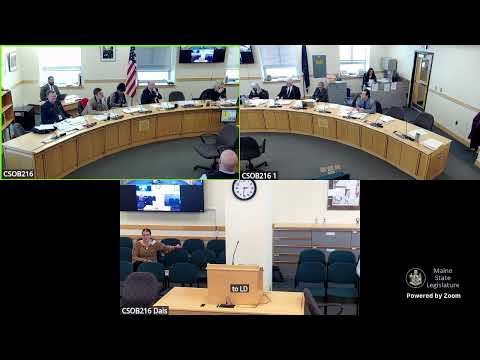
Lawmakers hear wide support and guarded opposition for RGGI update to 2037
Summary
At a public hearing on LD 2037, proponents including DEP, the Department of Energy Resources, Efficiency Maine, conservation groups and contractors said continued RGGI participation funds weatherization and heat-pump programs; an industry trade group warned higher allowance prices raise electricity costs and urged caution.
The committee heard hours of testimony on LD 2037, a department bill to incorporate the Regional Greenhouse Gas Initiative's (RGGI) 2025 model-rule updates into Maine law and continue participation through 2037.
Representative Chris Kessler framed the bill as protecting Maine's ability to receive auction proceeds that fund Efficiency Maine programs. Jeffrey Crawford, DEP Bureau of Air Quality director, testified that Maine has received over $290 million in RGGI auction proceeds through December 2025 and that proceeds have funded efficiency programs that lower consumer bills. "Participation enables Maine to reinvest allowance proceeds in energy efficiency and reduce exposure to fossil-fuel price shocks," Crawford said.
Michael Stoddard of Efficiency Maine and Dan Burgess (acting commissioner, Department of Energy Resources) described targeted uses of proceeds: weatherization for low-income households, heat-pump subsidies, industrial projects and energy-efficiency grants. Stoddard said FY23-FY25 investments are projected to deliver roughly $390 million in lifetime bill savings.
The Maine State Chamber of Commerce supported staying in the regional market while urging careful coordination with other state policies. Natural-resources and conservation groups urged passage to preserve both emissions reductions and program funds.
Opposition testimony came from the Industrial Energy Consumer Group, represented by attorney Todd Grissett, who argued higher RGGI allowance prices are already reflected in regional market clearing prices and may add more than $100 million per year to Maine electricity costs; he urged caution about removing offset categories and increasing ambition without more demonstration that benefits exceed rate impacts.
Committee members asked DEP and Efficiency Maine for additional data on projected revenues, geographic distribution of projects, and modeling assumptions. The hearing record will remain open to additional written testimony; staff will prepare follow-up materials for the work session.