Get Full Government Meeting Transcripts, Videos, & Alerts Forever!
Get email alerts on the Maine Clean Energy Authority topic
No spam. Unsubscribe anytime.
Debate over proposed Maine Clean Energy Authority centers on bonding, eminent domain and labor rules
Summary
Sen. Mark Lawrence's concept bill to create a Maine Clean Energy Authority drew broad testimony: supporters see public bonding as a way to lower transmission costs for ratepayers; opponents worry the draft grants unconstrained borrowing, eminent-domain authority, tax exemptions and stringent labor mandates; agencies urged narrowing scope and stronger guardrails.
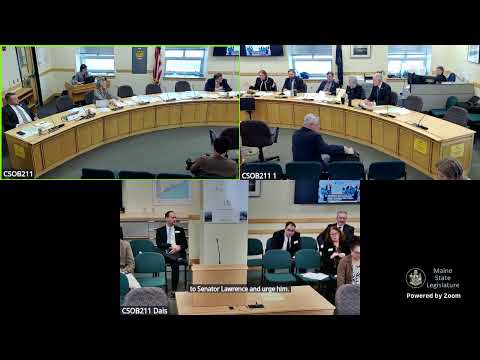
Sen. Mark Lawrence introduced LD 838, a concept proposal to explore a new public financing authority aimed at lowering the cost of building transmission and related grid infrastructure. Lawrence framed the measure as a financing tool, not a construction or siting authority: "The purpose of this bill is to find lower cost alternatives for financing transmission that will cost ratepayers less," he said.
The committee heard a mix of supportive and critical testimony. Supporters ' including the Natural Resources Council of Maine, Maine Conservation Voters, OurPower, Municipal Solar Partners, and the Maine Youth for Climate Justice ' said public financing or targeted revenue bonds can reduce up-front capital costs and bring benefits for workforce development, apprenticeships and long-term rate stability. Jack Shapiro (NRCM) recommended clarifying the authority's role relative to the Department of Energy Resources and the Public Utilities Commission and urged explicit project-selection criteria so the authority funds projects where public bonding adds marginal value.
Opponents including Preserve Royal Maine, the Associated General Contractors of Maine, the Maine State Chamber of Commerce and utility representatives (Central Maine Power and Versant Power) urged the committee to reject or substantially amend the draft. Tanya Blanchard of Preserve Royal Maine said the bill, as drafted, "grants phenomenal cosmic power with itty bitty accountability," and raised specific objections to eminent-domain provisions, broad property acquisition powers and exemption from local property tax that could erode municipal tax bases. Kelly Fagg of the AGC warned that mandatory project-labor agreements and apprenticeship quotas could exclude many Maine contractors and reduce competition.
Several witnesses, including the Department of Energy Resources (Carolyn Cohen), the Public Advocate's office and the Public Utilities Commission, urged a narrower, more targeted approach: use public financing tools for clearly identified system needs (for example, large-scale transmission with statewide benefits), set transparent eligibility criteria, include guardrails on bonding limits and repayment sources, and coordinate with regional processes (ISO New England).
Central Maine Power offered to arrange briefings on the New York State authorities (NYSERDA and NYPA) that Sen. Lawrence cited as models; CMP noted differences in scale and funding structures. Versant Power urged attention to benefits allocation, since transmission upgrades can produce value for customers outside Maine.
Committee members repeatedly noted the gap between the sponsor's verbal framing and the draft language: Lawrence said he submitted hurried language to start a conversation and welcomed amendments, but many testified that the draft delegates broad, ambiguous powers that require detailed work sessions to resolve. No vote was taken; the sponsor was asked to circulate refined committee language before any work session.
Next steps: committee staff and interested parties will likely develop narrower language and convene work-session briefings on options including revenue-bond structures, governance safeguards, and whether a standalone authority or an office within an existing entity would better achieve the sponsor's goal of lowering ratepayer costs.