Get Full Government Meeting Transcripts, Videos, & Alerts Forever!
Get email alerts on the Guard Cyber Capabilities topic
No spam. Unsubscribe anytime.
Minnesota National Guard details cyber response capabilities, training partnerships
Summary
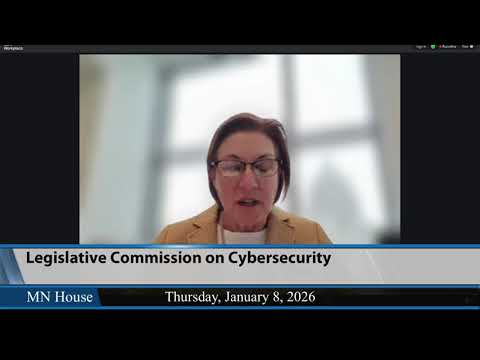
At a Jan. 8 meeting of the Legislative Commission on Cybersecurity, the Minnesota National Guard described its Cyber Coordination Cell, deployable incident‑response equipment, and training partnerships including Metro State University. Officials said the cell focuses on coordination, prevention and readiness rather than serving as the primary incident response team.
The Minnesota National Guard told the Legislative Commission on Cybersecurity on Jan. 8 that its Cyber Coordination Cell exists to prepare and enable Guard cyber forces for state and federal requests for military cyber operations support.
"Our primary goal and everything we do is directed towards ensuring that the Minnesota National Guard Cyber Operations Forces are prepared to respond to state or federal requests for any military cyber operations support," Lieutenant Colonel Brian Morgan, director of cyber coordination for the Department of Military Affairs, told the commission.
The presentation described three primary lines of effort: optimizing and training cyber forces against significant risks (ransomware, vulnerability assessment, threat hunting and operational-technology response); cultivating preexisting relationships with federal, state and local partners so coordination is faster in an emergency; and equipping teams with deployable hardware and software stored at the Cedar Street Armory.
Morgan said the Guard maintains deployable jump servers, laptops and "about 40 backpacks" of peripherals that can be issued when soldiers are placed on active duty; those kits include their own wireless networking via Cradlepoint and AT&T FirstNet for out-of-band connectivity. He cited the July Saint Paul response as an example where Guard-provided connectivity and equipment were used on-site.
Officials described the force structure as two primary elements: the 177th Cyber Protection Team (about 40 Army soldiers) and a defensive cyber operations element that fluctuates between about 5 and 10 personnel. Morgan said most members are traditional guardsmen who work in civilian jobs and that becoming mission-ready typically takes "anywhere between 7 months to 2 years" of specialized training.
The Guard emphasized partnerships with Minnesota IT Services (MNIT), the FBI cyber office in Brooklyn Park, the Cybersecurity and Infrastructure Security Agency, the Bureau of Criminal Apprehension, Homeland Security and Emergency Management, and academic partners such as Metro State University. Morgan noted Metro State provides an operational-technology lab and a cyber symposium the Guard uses for training and outreach; he also said the Guard has done "over 200 different engagements" with stakeholders between 2024 and 2025.
"We encourage entities we visit to adopt [state-subsidized security] services that MNIT offers," Morgan said, stressing prevention and shared resources as a way to reduce the need for response.
John Israel, an assistant commissioner for Minnesota IT Services and the state's chief information security officer, told the commission the partnership with the Guard "has been a phenomenal resource" and urged broader local participation in state programs.
The presentation concluded with an invitation to the commission to identify legislative barriers that might facilitate greater coordination and communication between the Guard and local entities.
The commission plans to take up related topics — including rural utilities and MNIT updates — at its next scheduled meeting on Feb. 11, 2026.