Get Full Government Meeting Transcripts, Videos, & Alerts Forever!
Get email alerts on the Internal Controls Mmb topic
No spam. Unsubscribe anytime.
State financial officials outline fraud‑prevention steps but say limited enforcement powers hamper accountability
Summary
Minnesota Management and Budget (MMB) described layered anti‑fraud controls, data analytics deployments and proposed statutory changes to sustain payment‑withholding authority, while acknowledging limited capacity to compel agency-level compliance. Lawmakers pressed MMB on gaps exposed in recent audits and program error rates.
Minnesota Management and Budget Commissioner Erin Campbell told the House Fraud Prevention and State Agency Oversight Committee that the state needs better data sharing, stronger internal controls and statutory authority to more quickly stop suspected fraud.
"There’s not a silver bullet to stop the type of fraud that we’ve seen in our public assistance programs," Campbell said, urging coordinated activity across agencies and investments in IT systems, staff and legal authority. She framed MMB’s role as enterprise controller and chief financial officer and described work to support agencies rather than unilaterally enforce program decisions.
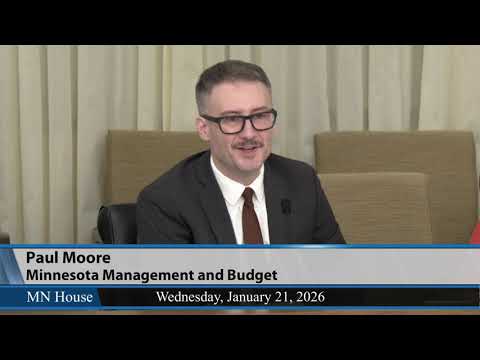
MMB assistant commissioner Paul Moore outlined operational controls: a 75‑person accounting services team that supports SWIFT (the statewide PeopleSoft financial system), daily bank reconciliations across more than 600 accounts, vendor‑profile management for roughly 380,000 vendors and centralized payroll for 59,000 state employees. Moore said the agency processes about 2,500,000 payments a year and has adopted a "zero trust" approach to verify bank‑account changes and stop vendor‑impersonation schemes.
Deputy Commissioner Britta Rayton described an internal controls framework that uses an annual Control System Assessment Tool (CSAT), corrective‑action tracking tied to Office of Legislative Auditor (OLA) findings, and training: "We require agencies to complete a control system assessment tool annually," Rayton said, adding that MMB is revising those tools to reflect recent updates to the U.S. Government Accountability Office Green Book.
Lawmakers pressed officials on the limits of MMB’s authority. Representative Schultz and others repeatedly asked why agencies continue to make payments that investigators later deem improper. Campbell responded that MMB has "limited line of sight" into whether statutorily authorized payments met program eligibility rules and that agency heads remain responsible for designing and maintaining internal controls under state statute.
Campbell said MMB will propose statutory changes this session to remove a sunset on payment‑withholding authority and to lower the evidentiary threshold for suspending payments when fraud is suspected. Rayton described an interagency work group created under Executive Order 25‑10 focused on data sharing, technology and workforce training to detect anomalous provider behavior more quickly.
The committee highlighted recent audit findings and behavioral‑health grant problems that showed falsified documents and backdating. Campbell and Deputy Christiansen of the Department of Administration said those instances triggered audits and referrals to the Bureau of Criminal Apprehension and the Attorney General’s office; Christiansen added that the Office of Grants Management has suspended or debarred 23 entities or individuals since May 2025 to keep known bad actors off state grants.
The hearing closed with members urging legislative fixes to give agencies clearer enforcement tools and with chair remarks that bills are in development to strengthen MMB’s ability to ensure enterprise‑wide internal control compliance.