Get Full Government Meeting Transcripts, Videos, & Alerts Forever!
Get email alerts on the Transportation Funding topic
No spam. Unsubscribe anytime.
Minnesota working group weighs mileage fees, per‑kWh taxes and surcharges to replace falling gas tax revenue
Summary
At a Jan. 5 working-group meeting, lawmakers and stakeholders debated how to make electric vehicles contribute to road funding, considering mileage‑based user charges, per‑kWh taxes on public charging and continuing or phasing out the EV registration surcharge; members stressed implementation feasibility, privacy and equity for apartment residents.
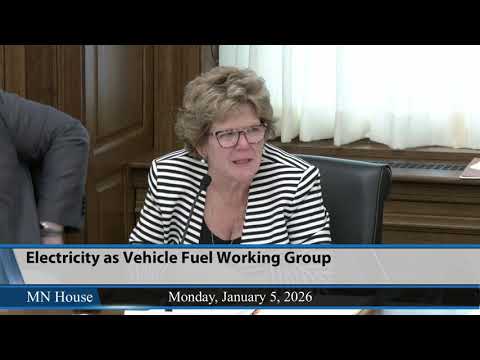
Minnesota’s Electricity as Vehicle Fuel Working Group met Jan. 5 as it races to finalize recommendations for a Feb. 15 report on how to fund roads and bridges as more vehicles switch from gasoline to electricity.
Chair opened the meeting by restating the group’s charge under Subdivision 5 of last session’s bill: analyze infrastructure opportunities and barriers for electricity used as vehicle fuel, develop a policy and funding roadmap consistent with the Minnesota Constitution, and study other states’ approaches. Staff reminded members the report will go to the governor and to legislative committee leadership.
The central problem members repeatedly returned to was simple: gasoline tax receipts, the backbone of Minnesota’s road funding, decline as electric vehicle (EV) adoption grows. Lawmakers and stakeholders sketched three broad responses under consideration: retain and refine the EV registration surcharge, levy a per‑kilowatt‑hour tax on charging, or move to a mileage‑based user fee (road‑user charge).
Representative Steve Elkins and others said taxing electricity delivered to vehicles is hard to do equitably because most charging occurs at homes. Elkins and multiple presenters pointed to Utah and Virginia models that allow opt‑in mileage reporting or phased mileage charges. Elkins showed a worked example converting a gas‑tax equivalent (about $189/year for one pickup example) into roughly 1.64¢ per mile and noted the same approach could translate into a per‑kWh amount based on a vehicle’s MPGe.
Countering that view, Senator Howe and some members argued the system could rely on tax‑time accounting or simple mileage proxies and still produce fair results without complex new hardware. Several members highlighted privacy and administrative burdens if per‑mile monitoring were required, and staff said available in‑car meter technology is not sufficiently reliable today for billing without additional meters or safeguards.
Industry and stakeholder witnesses stressed implementation realities. QuikTrip sought statutory clarification about how sales‑use‑excise taxes on electricity would be collected and whether collection schedules could align with utility billing to avoid disproportionate administrative costs. The Minnesota Trucking Association provided an industry figure—stating trucks currently pay about 32% of motorists’ taxes while representing roughly 11% of vehicle‑miles traveled—to argue heavy vehicles already shoulder a substantial share of road funding; members asked for supporting data.
Several presenters noted “double taxation” for drivers who pay sales tax on electricity and also face a separate EV surcharge. Drive Electric Minnesota warned that not all public fast‑charging is used by out‑of‑state drivers and urged the group not to assume public chargers only capture nonresidents.
Equity issues surfaced in public comments. A member of the public, Xavier Smead, said his father has difficulty enrolling in a utility time‑of‑use plan that would allow cheaper nighttime EV charging, and he urged grants or programs to help multifamily housing add charging capacity—an idea several members said should appear in the recommendations.
On rate‑setting, Representative Murphy offered an illustrative conversion: a per‑kWh rate near 6¢ could approximate current gasoline tax contributions in some scenarios, while staff and advocates pointed to Minnesota’s current 5¢/kWh figure used in earlier calculations as a starting point for discussion. Members emphasized that input variables—assumed average miles driven, vehicle MPGe and whether rates vary by vehicle class—will change outcomes and require careful modeling.
The group agreed to separate short‑term, operational recommendations (for example, clarifying tax collection timing and reducing admin friction) from longer‑term policy changes (pilots for mileage charges, trigger points tied to EV penetration). Members also discussed using nonbinding, electronic “temperature checks” before the next meeting to speed consensus while preserving open‑meeting requirements for any formal votes.
Staff committed to producing a topic‑categorized list of recommendations and to returning on Jan. 21 at 9 a.m. for continued discussion. The chair adjourned the meeting after attendees affirmed the approach to prioritize implementable, near‑term fixes and to flag broader policy issues for future work.