Get Full Government Meeting Transcripts, Videos, & Alerts Forever!
Get email alerts on the Land Use And Economic Development topic
No spam. Unsubscribe anytime.
Sherwood reviews Old Town strategic plan with focus on Pine Street streetscape, Columbia Avenue connection and parking strategy
Summary
Consultants previewed an Old Town strategic action plan that prioritizes extending the Pine Street curbless streetscape, studying a Columbia Avenue extension as a new 'front door,' creating a long-term parking strategy and preparing development guidance for city-owned sites including Site D.
City consultants presented a near-final Old Town strategic action plan at the Sherwood City Council work session on Nov. 4, asking for directional feedback before the plan goes to the planning commission and back to council for adoption by resolution.
"We're basically looking tonight for feedback on, you know, big picture, where the plan has landed," a consultant from First 40 Feet said, outlining priorities for preserving Old Town’s pedestrian character while encouraging targeted redevelopment on city-owned parcels.
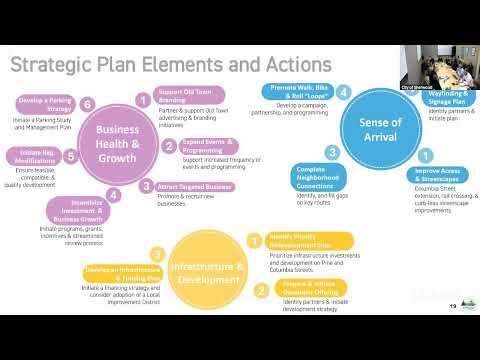
The plan highlights three broad goals: create a clearer sense of arrival, support business health and growth, and align infrastructure improvements to enable private investment. Consultants recommended extending Pine Street’s curbless streetscape — which they described as a defining downtown feature — and studying Columbia Avenue as a potential new entrance from Oregon Street to improve wayfinding and access.
Why it matters: The plan would guide city-owned redevelopment sites, influence future public investments (streetscaping, undergrounding utilities), and shape incentive packages and code changes that affect developers, merchants and residents in Old Town.
Consultants and councilors discussed trade-offs. Undergrounding utilities along Pine could unlock development sites but would be expensive; relocating or modifying the nearby fire station and negotiating with rail owners and ODOT Rail are additional constraints for proposed crossings and trail connections. On the rail corridor, presenters said pedestrian-only crossings may be more feasible than vehicle crossings and will require negotiation with rail owners.
Parking surfaced as a central concern: presenters proposed a long-term parking strategy and the possibility of reserving sites or using local improvement financing tools to fund infrastructure. "Creating a parking reserve is important," one councilor said, and consultants recommended studying parking needs at full build-out to identify whether reserved sites or parking structures will be required.
Business support recommendations include targeted events, collaborative branding, façade or seed grants, and nonfinancial incentives such as streamlined development review for priority projects. Consultants also recommended code adjustments for Old Town—such as conditional allowances for rear/on-site parking—to make projects financeable while preserving active ground-floor uses.
Next steps: Staff will advance detailed work on priority parcels (including Site D) and bring the draft action plan to the planning commission for public hearing, then to the city council for adoption by resolution. The presentation did not include any immediate council votes.
Ending: Councilors provided direction on priorities and site refinement; staff said they will incorporate the feedback before the public hearings and return with a final recommended action plan and implementing steps.