Get Full Government Meeting Transcripts, Videos, & Alerts Forever!
Get email alerts on the Public Safety Levy topic
No spam. Unsubscribe anytime.
County officials outline public safety levy to Sherwood council; cite jail capacity, mental‑health response and fentanyl seizures
Summary
Washington County presenters said a replacement public safety levy would raise the rate from 47¢ to 66¢ per $1,000 assessed value (about $6/month for a typical homeowner), fund prosecution, jail operations, juvenile services, parole/probation and mental‑health response teams, and help address forced releases tied to limited jail capacity.
Washington County officials briefed Sherwood councilors on a proposed replacement public safety local option levy at the Sept. 16 work session, describing how the levy supports the county’s multi‑agency public safety ecosystem and the specific services it would fund.
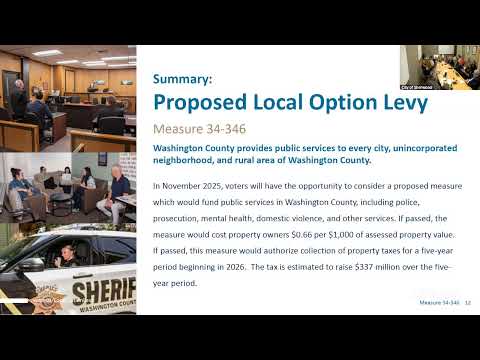
Kevin Barton (DA’s office) and other county presenters said the levy would increase from 47¢ to 66¢ per $1,000 of assessed value, producing roughly $337 million over the levy life and costing an average homeowner about $6 more per month. "We're going from, 47¢ per $1,000 of assessed value to 66¢," a presenter said while explaining the revenue and the components it funds.
County staff framed the levy as funding four core county components: the sheriff’s office (jail and patrol), the district attorney’s office, juvenile services and community corrections (parole/probation). They used a recent Sherwood shooting response as an example of cross‑jurisdictional investigative work funded through those shared resources.
Presenters described operational pressures: the jail was built with a 572‑bed design but current effective capacity is closer to about 388 beds because of staffing and infrastructure constraints; forced releases have occurred (about 2,400 people so far this year) and the system logged over 11,000 failures‑to‑appear last year, complicating prosecutions and case resolution. County staff said the levy would stabilize staffing, prosecutorial capacity, victim services and mental‑health response teams but would not by itself solve the long‑term jail capacity challenge.
The panel also cited drug enforcement outcomes, reporting an estimated 1,300,000 fentanyl pills seized over the last three years and describing the supply as largely illicit and pill‑pressed. Presenters emphasized that rising operational costs — from personnel to body‑worn camera review and centralized forensic work — increase the fiscal pressure on the public safety system.
Councilors asked whether the county would maintain general fund contributions as levy revenue rises and raised data‑privacy questions about automatic license plate reader (ALPR) systems and vendor security. County representatives said long‑term general fund commitments cannot be guaranteed in the current budget environment and described contractual and personnel safeguards intended to prevent misuse or data breaches.
Presenters urged support for the levy, noting its role in preserving multi‑agency responses, victim assistance and mental‑health teams; they will continue outreach ahead of the November ballot.