Committee tables work on expanding Maine Housing's construction‑loan authority for manufactured housing parks
Loading...
Summary
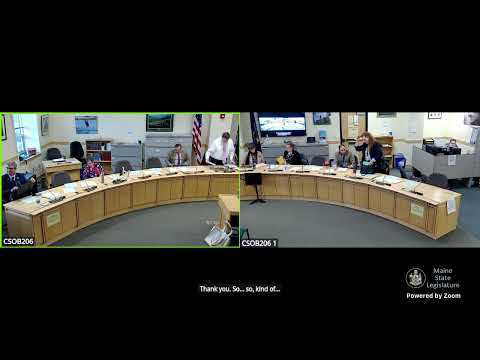
In a work session on LD 2057, lawmakers debated allowing Maine State Housing Authority to make construction loans to privately or cooperatively owned manufactured‑housing communities and to tie participation thresholds to federal rules. After testimony from Maine Housing and concerns from banks, the committee voted to table the bill and directed staff to rewrite the construction‑loan statute.
Committee staff opened the LD 2057 work session by summarizing the bill's two main changes: allowing Maine State Housing Authority to make loans to privately or cooperatively owned manufactured housing communities for rehabilitation or additional home sites, and lowering the agency participation threshold for certain construction loans by tying it to the federal low‑income housing tax credit (LIHTC) threshold rather than the current statutory 60 percent.
Dan Brennan, director of the Maine State Housing Authority, said subsection C would "open the door" for the authority to participate in construction lending in manufactured housing parks and stressed the agency's intent to bring lower‑cost capital to an otherwise constrained market. "Having Maine Housing have the ability to work in this construction lending in this area automatically brings with it a lower cost than otherwise would be there," Brennan said.
Josh Sherman of the Maine Bankers Association warned the committee that expanding Maine Housing's lending authority risks crowding out private lenders: "This is an expansion of the lending authority of Maine State Housing, that is very likely coming at the expense of private institutions." Committee members said they wanted to preserve the role of community banks while ensuring projects can access construction financing during the risky pre‑leasing period.
Rather than amend subsection B or C piecemeal, several members supported the analyst's recommendation to reframe and rewrite statute 4‑832 to set clearer construction‑loan authority and limits. Representative Collamore moved to table LD 2057 while staff redrafted a revised statutory approach; the motion was seconded and the committee agreed to table the bill to allow time for analysts and the sponsor to produce a restructured proposal.
The committee asked Maine Housing to provide comparative information on how other New England HFAs handle construction lending and to return with a rewritten statutory structure for consideration.