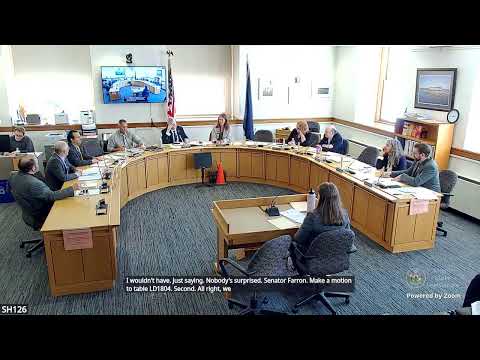
Maine transportation committee reviews LD 18 o4; sponsor moves to table amid revenue and oversight questions
Loading...
Summary
Lawmakers reviewed a sponsor's amendment to LD 18 o4 that would clarify the Transportation Committee’s jurisdiction over the Highway Fund, change revenue shares and reporting, and move some state police costs to the General Fund; after extensive staff briefings the sponsor moved to table the bill and the motion passed unanimously.
A joint legislative work session reviewed LD 18 o4, an act addressing funding and oversight of transportation matters, with members and agency staff examining statutory jurisdiction, revenue sources, procurement rules and proposed transfers of certain state police costs from the Highway Fund to the General Fund.
Representative Lydia Crafts opened the session and the sponsor, Senator Brad Farrin, said staff prepared a large packet of materials and that the committee sought ways to make the bill acceptable, including a revenue‑neutral approach. Legislative analyst Melanie Fuhrman walked the committee through a packet that included a printed bill analysis, a memo on oversight of financial matters, funding worksheets prepared with Office of Policy and Research staff (OFPR), and a sponsor’s amendment that would alter several statutory sections.
Fuhrman flagged potential statutory overlap between the broad oversight granted to the joint standing committee on appropriations and financial affairs (AFA) in Title 3 §5‑21 and the language in LD 18 o4 that would assert the transportation committee’s oversight of Highway Fund allocations; she said the sponsor’s amendment contains exclusion language intended to make clear that the transportation committee would have jurisdiction over the Highway Fund and recommended mirroring that exclusion in related statutes (Title 3 §5‑22; Title 23 §16‑52) if the committee wants to avoid ambiguity.
The committee discussed procurement language that removes the project/non‑project distinction so DOT can procure some materials outside a single project (for example, to help smaller contractors or respond to emergencies). Catherine Woltak, DOT director of finance and administration, explained how DOT purchases differ when DOT acts as project manager versus when a contractor procures materials and said the change aims to reduce administrative confusion that has varied by administration and by DAFS interpretation.
A significant portion of the briefing addressed Highway Fund composition and revenue: Fuhrman said section 5 adds automobile‑related sales and use taxes to the statutory list of Highway Fund revenue sources (an action staff described as bringing statute up to current practice). Fuhrman also described a reporting requirement in sections 8 and 10 that would require DOT and the Turnpike Authority to submit biennial procurement summaries beginning 03/01/2026.
Sections 6 and 11 of the sponsor’s amendment would shift many Department of Public Safety/state police expenditures from the Highway Fund to the General Fund beginning 07/01/2027 while preserving specific traffic safety, commercial enforcement and inspection programs in the Highway Fund. OFPR/DOT staff identified a ‘state police support’ account funded 100% from the Highway Fund at $875,421 and said the amendment would move that cost to the General Fund. Staff also gave a budgetary estimate that liquor operations net revenue is budgeted at about $59,000,000 in the next fiscal year and that transferring those amounts would materially change the Highway Fund and General Fund balances.
On revenue policy, the printed bill would have raised the Highway Fund share of automobile‑related sales and use taxes from 40% to 60%; the sponsor’s amendment reduces that proposed increase to 48% as part of a package meant to approach revenue neutrality when combined with moving liquor revenue and transferring expenditures. DOT and OFPR staff said the 48% figure, combined with the liquor revenue shift and current expenditure assumptions, is estimated to leave the General Fund slightly ahead (under about $500,000) under present‑year assumptions, but staff cautioned that historical isolation of the auto‑related sales tax is limited and that more trend data would be helpful.
Members raised process questions and concerns about precommitting capital funding without a clear, concurrent revenue plan. Fuhrman and DOT staff said section 7 would establish minimum baseline capital funding adjusted by CPI every two years so capital needs appear in the baseline submitted to the state budget officer; DOT staff said that inclusion would make capital more visible in the budget process but would not eliminate negotiation and might require future governors to submit initiatives or adjustments to balance budgets.
After questions and requests for additional data (members asked for five‑to‑ten year trends for liquor revenues and auto‑related sales tax receipts), Senator Farrin moved to table LD 18 o4. A member seconded; the chair called the question and the motion was recorded as unanimous. The committee closed the work session on LD 18 o4 and adjourned.
What’s next: Committee staff said they will provide additional revenue trend data, more detailed breakdowns of the Highway Fund and the identified state police accounts, and drafting options for statutory cross‑references if the committee chooses to work further on the sponsor’s amendment.