Get Full Government Meeting Transcripts, Videos, & Alerts Forever!
Get email alerts on the Public Safety Funding topic
No spam. Unsubscribe anytime.
Sherwood council reviews levy, fee options after consultant models local option levy impact
Summary
City leaders heard a presentation from Piper Sandler showing Sherwood’s property-tax structure gives room for a modest local option levy with limited compression for most households; council members asked staff for a menu of levy/fee scenarios and agreed to a follow-up work session to refine options and consider polling.
Sherwood City Council members spent their January work session probing options to fund public safety, weighing a voter-approved local option levy against commercial and residential fee alternatives. David Williams, a consultant with Piper Sandler, explained how Oregon’s assessed-value system and Measure 5/Measure 50 rules create a gap between real market value and assessed value that a local option levy can target.
Williams told the council that local option levies are typically five-year operating levies that can be levied as a rate per $1,000 of real market value or as a fixed dollar amount, and that they are subject to voter approval. "It can be levied as a rate per thousand or a fixed dollar amount," he said, adding that most jurisdictions use a rate because it captures community value growth.
Using county assessor data, Williams said Sherwood’s overall assessed-value-to-real-market-value ratio is about 54 percent, with residential property averaging about 53 percent and representing roughly 68 percent of taxable value. That mix, he said, generally reduces the risk that Measure 5 compression will cut levy collections at modest levy rates. "You don't have compression in your permanent rate collection," Williams said, noting Sherwood’s consolidated tax rates sit below the Measure 5 cap for many properties.
Williams ran modeled examples showing most residential properties would remain well below Measure 5 caps at plausible levy levels, producing negligible compression. He contrasted that with some commercial parcels that are close to parity (one Sherwood commercial parcel was modeled at about 94.8 percent AV/RMV); those parcels could hit Measure 5 limits and see collections compressed if levy rates rise significantly.
Council members asked practical questions about design and equity. Speaker 1 asked whether a levy could be applied only to certain property types; Williams advised consulting counsel and the assessor and cautioned about implementation complexity, saying his modeling assumed an all-property levy. Council members also discussed election timing and the double-majority rule that affects special-election dates.
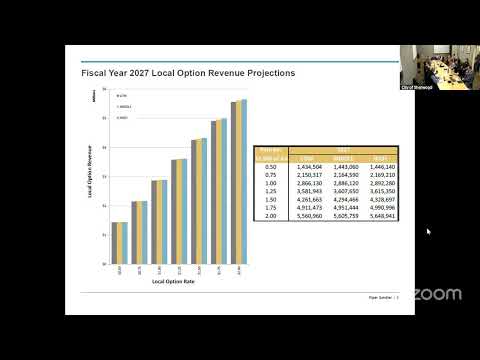
On revenue targets, a council member (Speaker 5) told colleagues that initial conversations with the police chief and staff suggested a target of about $2.5 million per year to address public safety needs. Council members asked staff to return with a clearer menu showing what different dollar amounts would buy — for example, the cost to maintain existing services versus restore or expand positions or programs.
Fees emerged as an alternative or complement to a levy. Speaker 1 described a commercial-only fee used elsewhere that is prorated by square footage; such a fee would not require voter approval under the city charter, whereas a residential utility-style fee would. Council asked staff to research fee structures used by other cities and to provide models showing commercial-only and residential-fee options and trade-offs.
Williams recommended sensitivity testing and polling. He said his firm modeled low, baseline and high-growth scenarios and tested sensitivity to real market-value declines; the models assume assessed values grow at the statutory 3 percent per year. Staff and council agreed the next step is a follow-up work session with an itemized 'menu' of levy and fee options, collection estimates by rate and service package, and polling data to test public support.
The council did not vote on any measure at the session. Members directed staff to prepare refined levy/fee scenarios, cost breakdowns (a per-thousand menu tied to service items), and comparative examples from other jurisdictions. They also agreed to schedule a subsequent work session to review those materials and the results of any polling before deciding whether to pursue a ballot measure or adopt fee-based approaches.