Get Full Government Meeting Transcripts, Videos, & Alerts Forever!
Get email alerts on the Ethics Complaint topic
No spam. Unsubscribe anytime.
Franklin Ethics Commission allows complaint against Alderman Matt Brown to proceed, flags timeliness and personal-knowledge gaps
Summary
At a Dec. 1 special meeting the Franklin Ethics Commission voted to allow a complaint filed against Alderman Matt Brown to proceed to an initial determination while finding several claims may be time-barred or based on secondhand information; the commission also approved prior minutes and bylaw revisions.
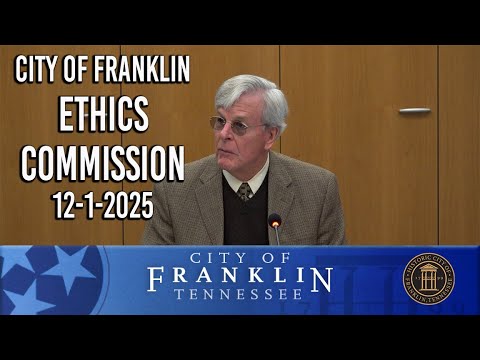
FRANKLIN — The Franklin Ethics Commission on Dec. 1 reviewed a complaint filed against Alderman Matt Brown and voted to allow the matter to proceed to an initial determination, but commissioners said portions of the complaint appear untimely or lack the personal-knowledge required by the commission's bylaws.
Chair Jim Martin opened the special-call meeting and confirmed the commission had received a complaint dated Nov. 13, 2025 and received Nov. 18, 2025; he instructed staff to correct a letter's date in the record to show receipt on 11/18/2025. The commission also approved its Oct. 23, 2024 minutes and voted to adopt previously discussed revisions to the commission bylaws.
Martin said the commission's immediate job was not to decide guilt or innocence but "to make an initial determination" about whether the complaint, if the alleged facts were true, would constitute an ethics violation. He read the commission bylaw that governs evidentiary threshold, saying the bylaws require that "the complaint shall be based on personal knowledge, set forth such facts as would be admissible in evidence, and shall show affirmatively that the complainant is competent to testify to the matter stated therein."
Commissioners summarized the complaint's allegations as covering incidents on Oct. 6, Oct. 9, Oct. 10, Oct. 22 and Oct. 23, 2025. Members focused on two threshold issues: the commission's 30-day timeliness rule (with a six-month exception if a violation was concealed or later discovered) and the requirement that allegations rest on personal knowledge rather than third-party reports. Several commissioners said items they reviewed appeared to be secondhand — for example, allegations relayed to the complainant by volunteers or by a third party identified in the packet — and therefore do not meet the personal-knowledge rule.
One commissioner summarized the panel's initial read: items 1–3 are likely untimely under the 30-day rule, item 4 lacks personal knowledge, item 6 lacks personal knowledge, and only item 5 appears both timely and possibly supported by firsthand information. Commissioners noted two procedural paths: dismiss time-barred or non‑compliant allegations, or allow the complainant to amend the filing; the bylaws allow an amendment within seven days in appropriate circumstances.
The record includes a letter dated Nov. 25, 2025 from Jeffrey D. Mosley, who is identified in the record as representing Alderman Brown, to Shauna Billingsley. The commission placed that letter into the file as part of the respondent's response materials.
After discussing thresholds and next steps, the commission took a motion and voted to allow the complaint to proceed for the commission's initial determination and to permit Alderman Matt Brown to participate in proceedings. The meeting concluded with the chair adjourning the special-call session.
The commission's actions were procedural: the panel did not make a final finding on the merits of any allegation. Members noted they must apply the bylaws' timeliness and personal-knowledge standards before moving to any investigatory or sanction steps. The commission indicated that, if dismissal occurs for particular allegations, it may still permit amendment where the bylaws allow it; conversely, allegations that survive the threshold review will proceed to the commission's subsequent procedures for contested complaints.
The Ethics Comission's file for this matter includes the original complaint, the Nov. 25 response letter from Jeffrey D. Mosley, and the corrected receipt date (11/18/2025). The commission did not record a roll-call vote tally in the minutes provided at the meeting; the chair announced the vote in favor and adjourned the meeting.