Get Full Government Meeting Transcripts, Videos, & Alerts Forever!
Get email alerts on the Municipal Finance topic
No spam. Unsubscribe anytime.
West Linn council workshop narrows priorities to maintain services and stabilize staffing, asks staff for strategic financial plan
Summary
At a special West Linn City Council work session on Oct. 8, councilors prioritized maintaining current service levels and stabilizing staffing, discussed funding options (fees, levies, bonds, urban renewal) and asked staff to draft a strategic financial plan with cost estimates, sequencing and community engagement options.
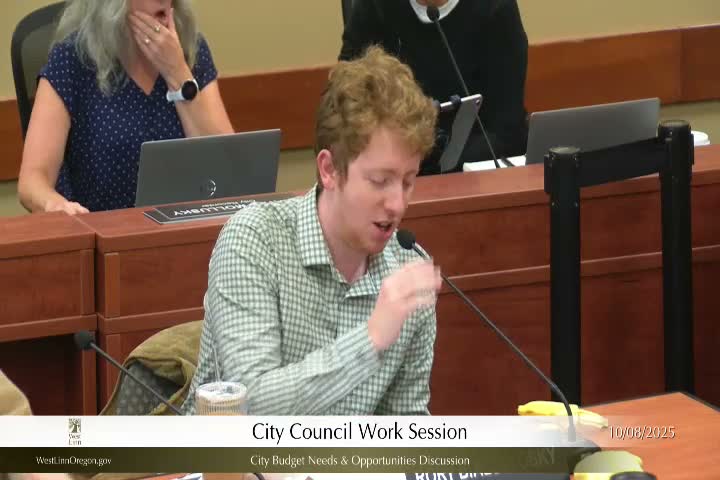
West Linn — Councilors at a special West Linn City Council work session on Oct. 8 focused the morning on identifying funding priorities and how the city might pay for them, rejecting broad, unfocused ballot packages in favor of narrower, more sellable proposals.
The meeting, facilitated by consultant Sarah Wilson, began with a short engagement exercise and moved into a strengths–problems–opportunities–threats conversation that highlighted the city’s strong community trust and waterfront assets alongside a constrained revenue picture and very lean staffing. "First being to establish shared financial priorities," Wilson said as she framed the session’s goals.
Councilors and staff agreed that the top near-term priority is to protect and maintain current service levels and to stabilize staffing where departments are one-person thin. In a dot-prioritization exercise, maintaining service and staffing received the most support from both council and staff. Participants flagged utilities and basic infrastructure (water, sewer, roads), deferred facilities maintenance, and select amenity projects — such as a modest Phase 1 waterfront amenity and targeted improvements at Parker Road or Oppenlander — as next-tier priorities.
Staff and council discussed funding tools they could use for different purposes. Fees and charges (including a cited example of a public safety fee described as "a $20 a month public safety fee ... About $2,000,000 a year") were identified as a near-term way to shore up operating services. Bonds and levies remain options for larger capital or amenity projects, while urban renewal/TIF districts can support targeted property investments and infrastructure in defined areas.
Council members and staff also reviewed lessons from peer jurisdictions. Staff cautioned against packaging "everything in the kitchen sink" into a single ballot measure and pointed to Tigard and Happy Valley examples where narrowly focused measures (for example, a dedicated public safety levy) eventually succeeded after narrower framing and careful polling. Milwaukee’s recent public safety fee was cited as a model for concrete messaging tied to defined positions and services.
Rather than decide detailed funding measures in the session, council asked staff to prepare a draft strategic financial plan. The direction asked staff to: list priorities identified in the workshop; estimate the cost to stabilize and maintain service levels and the cost ranges for identified projects (Phase 1 waterfront amenity, Parker Road improvements, deferred facilities maintenance, utilities work); propose sequencing and likely funding sources for each item; and outline community engagement and polling options to test voter willingness. The council emphasized the need for specific, concrete asks that can be clearly communicated to voters and stakeholders.
Consultant and staff proposals for community outreach included open houses, a short two-question pulse survey sent through city channels, and an online interactive prioritization tool (a "digital dot exercise") so residents can indicate what they would back. Danielle Choi, the city’s community relations coordinator, noted resource limits for communications: "we do have resource limitations as far as the kind of proactive communication that's being asked for," she said, stressing that effective engagement will require staff time and careful planning.
There were no public speakers signed up for the meeting. The session closed with staff confirming they could return promptly with a draft plan and cost estimates for council review; the mayor adjourned the workshop.
Next steps: staff will prepare a draft strategic financial plan that includes estimated costs, sequencing, and recommended funding tools and outreach tactics, then bring it back for further council direction and refinement.