Get Full Government Meeting Transcripts, Videos, & Alerts Forever!
Get email alerts on the Open Meetings topic
No spam. Unsubscribe anytime.
Nampa council delays vote on resolution to "cure" alleged Open Meetings violations after heated debate
Summary
Council members spent more than an hour debating a proposed resolution that would retroactively nullify past actions taken after executive sessions and "cure" alleged technical violations of Idaho’s Open Meeting Law. Legal counsel said the draft resolution would, as a matter of law, resolve any procedural issue; several council members said they do
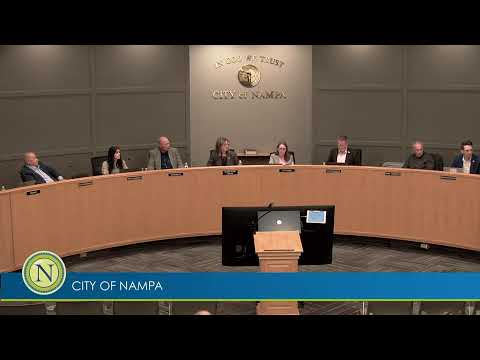
A contentious agenda item that asked the City Council to adopt a resolution "to preemptively cure alleged violations" of Idaho’s Open Meeting Law was continued to a Nov. 7 special meeting after more than an hour of debate.
The proposal, presented as Item 5.5, would declare certain prior actions null and void and enact a narrow, statutory cure intended to resolve what the city attorney described as "technical" and potentially non‑substantive procedural irregularities. City Attorney Preston Rudder told the council, "the proposed cure that's here tonight before you, would as a matter of law cure any alleged technical violation." (Preston Rudder, city attorney, 01:00:43)
Several council members pushed back, saying they had not seen a formal complaint and that the remedy would in effect concede wrongdoing without specifics. Councilwoman Karen Jangula said she had "issue with that because I haven't witnessed any of my council members in violation of anything. We've had integrity," and called for any formal allegations to be shown publicly before the council took action. (Councilwoman Karen Jangula, 01:00:30)
City legal staff said the city had received only a "courtesy letter" from a county prosecutor flagging potential technical violations and that a conflict prosecutor in another county had been assigned to the matter. Rudder said the prosecutor indicated the council's proposed cure would "level set everything" and "allow the city to proceed forward." (Preston Rudder, 01:02:23)
Council members repeatedly asked for written confirmation from the special prosecutor about whether the proposed cure would end the inquiry; legal counsel reported that conversations had taken place by phone but that a written ruling had not been produced during the meeting. Several council members said they wanted the prosecutor's written position before making a decision.
Public statements and exchanges on the dais became sharply personal at times. Councilmember Victor Rodriguez and others raised questions about executive‑session procedures, the confidentiality of those sessions, and whether "direction of intent" in closed session crossed the line into decision‑making that must be public. Council President Sebastian Reynolds said he wanted the council to consider bylaws and an enforceable code of conduct to address confidentiality lapses and the problem of executive‑session material reaching the public record.
After extended argument and legal clarifications, the council voted to continue Items 5.5 and 5.6 to a special meeting scheduled for Nov. 7 at 7:30 a.m. so that the city could obtain additional written guidance and give the council time to consider bylaws and procedural language.
What happened next
No formal cure was adopted on Nov. 3. Instead the council deferred a decision to a specially scheduled meeting on Nov. 7 so the body could consider written legal guidance from the special prosecutor and to allow time for staff and counsel to draft potential bylaws or procedural safeguards for future handling of executive sessions.
Why this matters
Idaho statute provides a limited mechanism by which a public agency can "cure" certain Open Meetings Act violations through self‑recognition (Idaho Code § 74‑208(7)(a)(i)). The council’s discussion centered on whether the circumstances here were the kind of narrow, procedural technicality that the statute contemplates or whether the matters raised went to the substance of prior decisions and therefore required a different process. The council’s deferral leaves the legal question unresolved pending the special prosecutor’s written position and any draft resolution or bylaws the council may adopt.