Get Full Government Meeting Transcripts, Videos, & Alerts Forever!
Get email alerts on the Government Transparency topic
No spam. Unsubscribe anytime.
House committee adopts amendment narrowing contract oversight provisions in Senate Bill 5
Summary
The House Ways and Means Committee adopted Amendment 10 to Senate Bill 5, keeping AI reporting and federal-fund notification but narrowing contract disqualification language and excluding INDOT from certain reporting and contract terms; a separate amendment proposing salary forfeiture for noncompliant, separately elected officials failed on a roll‑
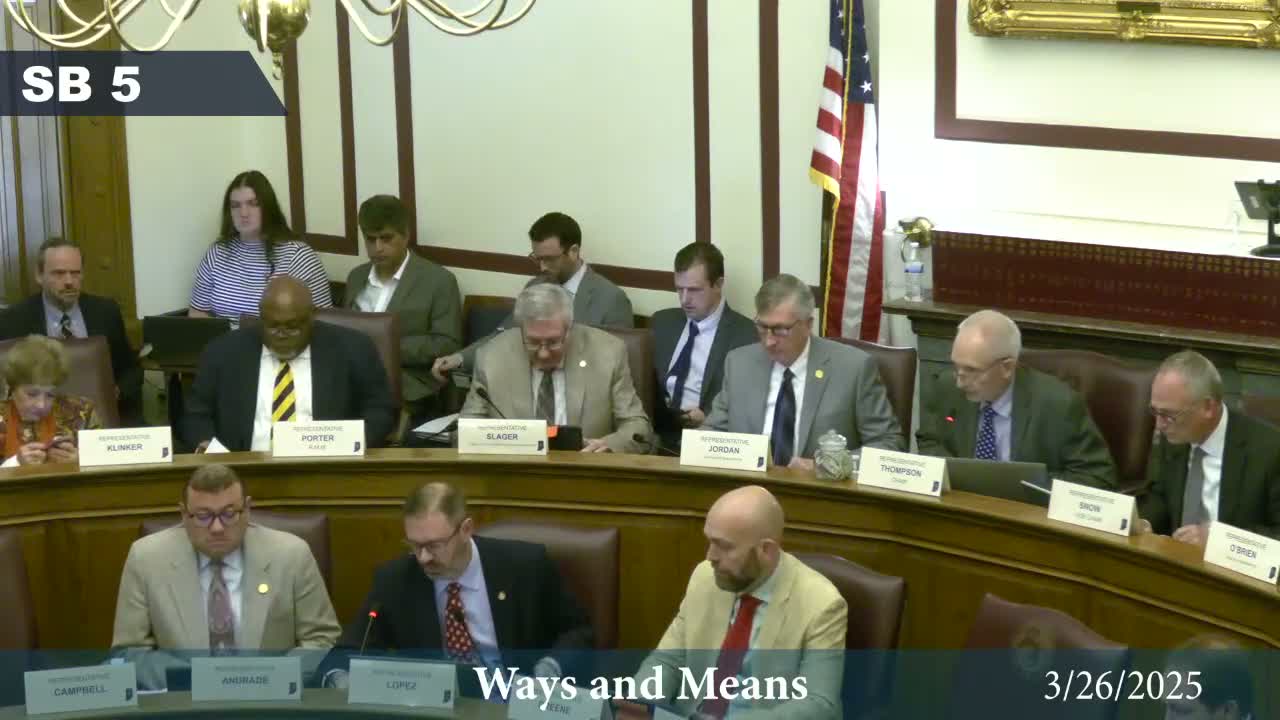
Representative Thomas Layman, offering Amendment 10 to Senate Bill 5, told the House Ways and Means Committee the change refines the bill’s approach to financial responsibility and transparency while removing provisions the administration can already address under existing law. “We allow new structure of transparency and accountability, and we want to make sure we’re staying in our legislative lane,” Layman said as he walked the committee through the merged amendment.
The amendment leaves in place a provision allowing use of artificial intelligence for reporting and maintains a requirement that agencies report new federal-fund requests; it adds a review requirement when a federal grant application would require matching state funds. “If it’s going to involve some state money, then that process does now go through a review process of the budget committee before applying for the said funds,” Layman said.
Amendment 10 also tweaked language around posting contracts to the state transparency portal, shifting some responsibilities from the comptroller to the administration while leaving the comptroller as the portal’s controller. It excluded Indiana Department of Transportation projects from several new reporting and mandatory-contract-term requirements (noting INDOT’s linear road projects), raised a reversion threshold from 60 to 90 days for a specified provision, and added language contemplating liquidated damages or other remedies for missed deadlines. The amendment clarifies scope and “success matrix” expectations “to the extent practical,” Layman said.
Representative Jordan Porter pressed for clarity about whether the budget committee’s role on federal funds had been reduced; Layman said the committee would still review requests that involve state matching funds but that projects without state dollars would be handled via quarterly reports.
Representative James Delaney offered Amendment 9, which would have imposed a 10% annual salary forfeiture for separately elected officials (for example, a comptroller) who failed to comply with the bill’s contracting rules. Delaney described it as “a mechanism to encourage separately elected officials to comply with this law.” Committee leadership urged against adopting the punitive measure. A roll call was held; the motion failed on a recorded vote of 6 to 15.
Amendment 10 was adopted by consent. The committee then voted to move the amended bill out of committee by a voice/roll call vote that was recorded as 22 to 0 in favor. The committee discussion indicated several targeted changes were made to focus statutory changes on state agencies and to avoid duplicating authorities the administration can already exercise.
What remains in the bill as amended: AI reporting language; a budget‑committee review requirement when new federal funds include state matching dollars; contract posting and transparency provisions with adjusted administrative responsibilities; a 90‑day vacancy reauthorization procedure for budget directors regarding certain positions; exclusions for INDOT on specified contract reporting and mandatory-term obligations; and the deletion of a separate statutory disqualification chapter that had been in earlier drafts. Several committee members asked staff and the authors to continue refining definitions and the timing of independent verification and validation provisions.
The committee did not adopt Delaney’s salary-forfeiture proposal; that failed in a recorded roll call. The committee voted to pass the amended Senate Bill 5 out of committee, recorded as 22 to 0.
Looking ahead, committee members asked for continued conversation about timing for independent verification provisions and for any future technical fixes to be considered in subsequent sessions if needed.