Get Full Government Meeting Transcripts, Videos, & Alerts Forever!
Get email alerts on the Immigration Detainers topic
No spam. Unsubscribe anytime.
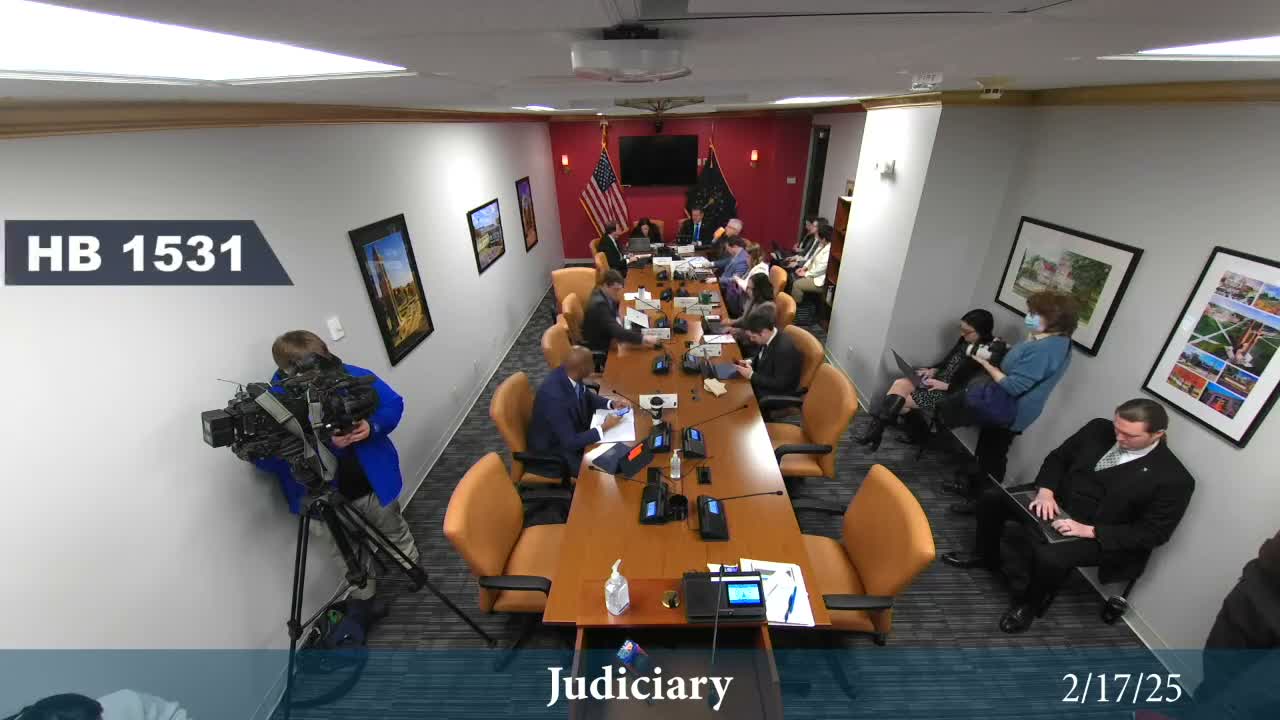
Indiana Judiciary Committee advances wide-ranging immigration bill after contentious hearing
Summary
The Judiciary Committee moved House Bill 15-31—an omnibus immigration measure—as amended after hours of testimony that split law enforcement, business groups and immigrants’ advocates. The bill requires compliance with ICE detainer requests, adds new employer penalties and reporting requirements, and directs state agencies to share certain data; it
House Bill 15-31, an omnibus immigration measure authored by Rep. Chris Prescott, advanced out of the Indiana House Judiciary Committee on a 9-4 roll call after more than two hours of testimony from state officials, sheriffs, business groups and immigrant advocates.
The bill, as amended in committee, requires local governmental entities to respond to federal immigration detainer requests, creates a civil enforcement pathway led by the attorney general, expands a state-level prohibition on knowingly employing unauthorized workers while preserving an E-Verify safe harbor option, and adds data-sharing and reporting requirements including a new parole-sponsor filing tied to the Department of Revenue.
The bill’s author, Representative Prescott, summarized the legislation at the hearing: “House bill 15 31 is a various immigration bill that I’ve been working on the past few months, with the attorney general’s office and other various parties,” and said the measure had been modified in committee to remove and clarify several provisions.
Why it matters: Supporters say the bill addresses gaps in the state’s ability to respond to interior immigration enforcement and to curb illegal employment; opponents say it will chill immigrant cooperation with police, risk Fourth Amendment litigation, and could harm students and families by creating fear of enforcement.
What the bill does (high-level)
- Detainer obligations: The amended bill directs that governmental bodies must document ICE immigration detainer requests, notify judges in bail proceedings, and comply with authorized immigration officer requests for custody within a 48-hour administrative window. The committee adopted language replacing some “federal authority” references with “authorized immigration officer.”
- Employer enforcement and safe harbors: The measure makes it unlawful for an employer to knowingly or intentionally recruit, hire or employ an unauthorized alien; it creates an escalating penalty scheme and preserves a safe harbor for employers who use E-Verify or follow AG-issued guidance described as “industry best practices.”
- Data and sponsor reporting: The bill would require parole sponsors (defined in the bill as persons who submit a Form I-134A to USCIS) to file that form with the Department of Revenue; it also directs certain FSSA data be shared with the attorney general on noncitizen recipients of specified benefits.
- Other changes: The amendments removed the bill’s education reporting provisions and narrowed some enforcement tools; the governor is given discretionary authority to withhold state grants to noncompliant governmental bodies for up to one year in specified circumstances.
Supporters and enforcement rationale
Blake Lanning, assistant chief deputy in the attorney general’s office, told the committee his office had worked with Rep. Prescott and “we’re supportive of the bill and think that it would do a lot to address some of the immigration related challenges that our state’s facing.” Lanning said the AG’s office has used recent authority to enforce the state’s sanctuary policy and that litigation against some sheriffs showed statutory gaps the bill seeks to clarify.
Several business and trade organizations testified they had worked with the bill author and the AG’s office on the employer provisions. Sam Sharon of the Indiana Manufacturers Association said amendments he requested made the employment section mirror federal employment standards and moved the industry group to neutral. Adam Berry of the Indiana Chamber said his members would work with the AG on guidance but stressed concern about imposing burdensome requirements on otherwise law-abiding employers.
Law enforcement views and liability concerns
Sheriffs’ groups supported clarifying procedures but pressed the committee for protections against litigation and operational burdens. Steve Luce, executive director of the Indiana Sheriffs Association, urged a streamlined detainer process: “The detainer is only a choice the sheriff gets to do. It’s administrative. But no sheriff wants to release a bad person out on the street, but you do have a window of 48 hours.” Sheriffs and county officials repeatedly raised worries that incomplete ICE paperwork, slow federal follow-up, or mismatches in records could leave local jails holding people beyond allowed periods and expose counties to lawsuits and fiscal strain.
David Bodorf of the Association of Indiana Counties said insurer and liability concerns were driving county skepticism and asked whether the state would agree to defend or assist counties facing litigation over detainer compliance.
Privacy, Fourth Amendment and capacity
Committee members and witnesses debated constitutional risk. The AG’s office argued the weight of appellate authority supports honoring administrative detainers and said the state could join counties in litigation defending compliance; several members voiced concern that the Gonzales and other recent federal rulings raise Fourth Amendment risks if detainers lack a neutral probable-cause finding.
Witnesses also stressed detention capacity: several sheriffs and detention experts said Indiana jails are operating near capacity and noted people sometimes are transferred far from their home counties when ICE beds are not available.
Opponents: community and immigrant advocates
Dozens of residents, educators and advocates testified in opposition. Indianapolis City Councilor Jesse Brown said, “Children in our city and in our state are staying home from school because they're afraid of being arrested and deported.” Educators warned the originally proposed school reporting requirement had been removed, but continued concerns about chilling effects on school attendance and victim reporting remained central to opponents’ testimony. Survivors’ advocates said the bill would deter victims of domestic violence and trafficking from contacting police.
Specific points of debate
- E-Verify and employer enforcement: Some witnesses, including RJ Halman (Border Security and Immigration Center), urged mandatory E-Verify; others said that would impose costs and operational burdens. The committee accepted language that preserves E-Verify as a safe-harbor option and adds an AG-guidance alternative for employers that implement industry best practices.
- Attorney General enforcement authority: The bill gives the AG expanded civil enforcement tools to seek injunctions, fines and, under some circumstances, recommend withholding of state grants from noncompliant governmental bodies; critics warned those remedies could reduce local services and complicate state-local relations.
Committee action and vote
After testimony and discussion the committee voted to pass House Bill 15-31 as amended on a recorded roll call. The clerk recorded nine members voting yes and four voting no: Yes — Chairman Jeter; Reps. Zimmerman, Ireland, Davis, Bascom, Meltzer, Prescott, Lopez and Stewart. No — Reps. Garcia Wilburn, Burton, Dvorak and Bauer. The measure advanced from committee.
What’s next
The bill’s author said he will continue to work with stakeholders on drafting and implementation questions. Supporters urged the committee and the House to refine guidance from the AG’s office on employer diligence and to consider fiscal support and legal protections for counties. Opponents urged the legislature to pause and pursue federal reform or different state approaches that would avoid chilling immigrant access to schools, health care and criminal justice.
Ending note
The committee’s passage sets up a House floor debate that will focus on the balance between interior immigration enforcement, local capacity and constitutional risk. Lawmakers will have to weigh enforcement goals against the litigation, fiscal and community-trust implications raised repeatedly during the hearing.