Get Full Government Meeting Transcripts, Videos, & Alerts Forever!
Get email alerts on the Healthcare Omnibus topic
No spam. Unsubscribe anytime.
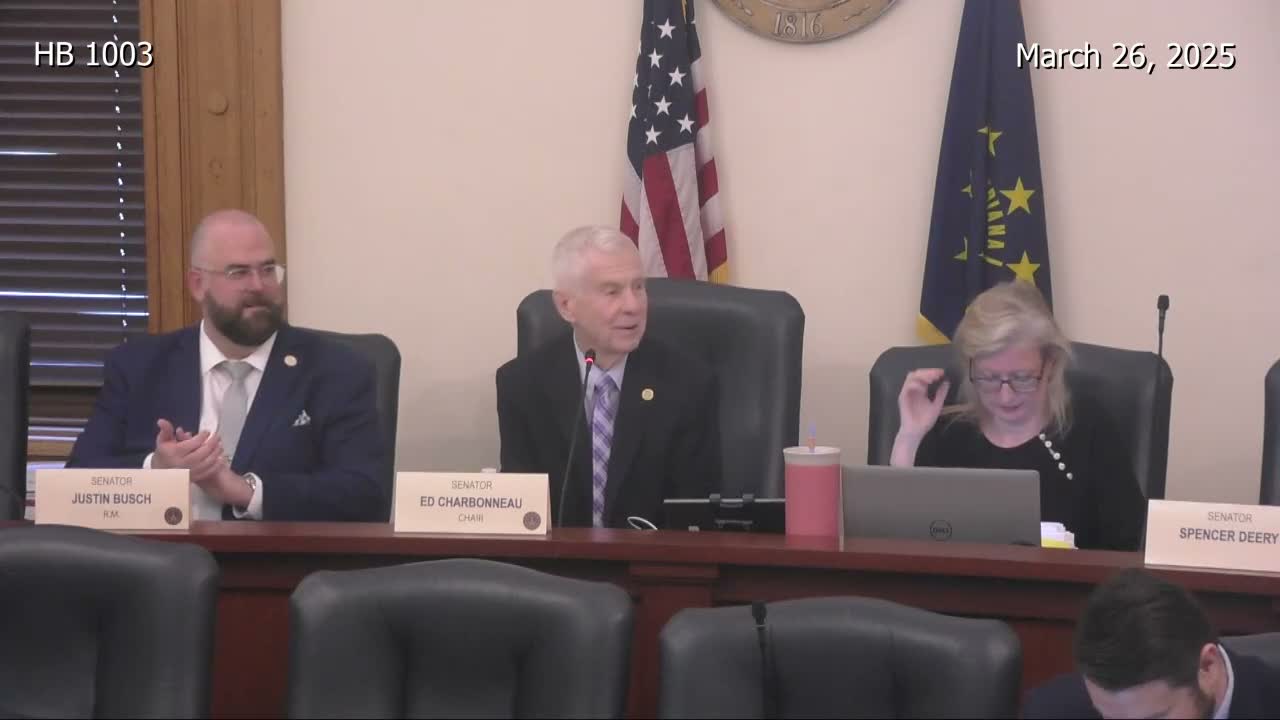
Lawmakers, providers and insurers spar over broad health omnibus bill at Senate hearing
Summary
Lawmakers heard hours of testimony on House Bill 1003, an omnibus health-care bill authors described as a "patient-friendly" package that would change surprise-billing rules, site-of-service payments, prior authorization, 340B drug rules, data access and fraud enforcement. The committee held the bill for a week to allow amendments and further work.
Rep. Brad Barrett, the bill's author, told the Senate Health Committee that House Bill 1003 is a wide-ranging, patient-focused package intended to lower costs, increase transparency and expand access.
"It's a pretty thorough bill. I think 56 pages, 102 sections, 8 different titles," Barrett said as he opened testimony, adding the measure aims to "lower cost, fight waste, fraud, and abuse, ... enhance transparency, expand access ... promote wellness, and increase competition." Barrett told the panel he expected further amendment work after the hearing and said the committee would hold the bill for a week.
Why it matters: HB1003 would touch multiple pieces of Indiana health policy at once — surprise billing, site-of-service payment differences, prior authorization rules, pharmacy benefit manager oversight, 340B drug program limits, the state's all-payer claims database (APCD) access and Medicaid fraud enforcement. Stakeholders from hospitals, employers, insurers, patient advocates and state officials said many provisions matter to patient access, provider finances and the state budget.
Key provisions and debate
Surprise billing and network adequacy — Barrett and others said the root problem is out-of-network providers working at in-network facilities. Barrett said the bill seeks to strengthen network adequacy and reduce situations where a patient goes to an in‑network facility and later receives an out‑of‑network bill. Several hospital and provider witnesses warned that payment limits or a blunt site-neutral approach could force service reductions or closures at smaller hospitals.
Site of service and payment — The bill includes site-of-service reforms that would change how outpatient procedures and imaging are paid depending on location. Hospital leaders warned the changes, if implemented broadly as written, could impose steep revenue cuts and threaten small and rural hospitals. Hendricks Regional Health CEO Dr. Michelle Finetti told the committee that a one-size-fits-all payment change would be "potentially risky to patient care" because it does not account for differences in patient acuity or the cost structure of smaller systems.
340B drug program — HB1003 contains language limiting resale markup for drugs acquired under the federal 340B program. Hospitals, federally qualified health centers and community clinics testified that 340B savings fund many services for low-income and uninsured patients. Several witnesses urged instead pursuing transparency reforms in Senate Bill 118 and warned that strict limits could reduce services for vulnerable patients.
Prior authorization and credentialing — The bill would restrict rescission of prior authorizations and require clinical-peer review of denials; it would also create provisional credentialing windows to ease physician transitions. Providers and patient advocates urged stronger prior-authorization reform, with some clinical speakers giving concrete examples of potential harm when authorization delays occur. FSSA and hospital representatives discussed trade-offs around who should make final determinations and how to avoid administrative burdens.
Medicaid fraud enforcement — Matthew Whitmire, director for the Indiana Medicaid Fraud Control Unit (MFCU) at the Attorney General's Office, supported provisions in HB1003 that would provide selected MFCU investigators with sworn law-enforcement authority. Whitmire said the unit has returned recoveries and convictions in past years, and that limited law-enforcement powers would enable investigators to execute search warrants, access criminal databases and collaborate with local prosecutors. Whitmire said the unit has produced "over $216,000,000 in recoveries." He noted the state is one of 10 of 53 Medicaid Fraud Control Units that currently lack sworn officers and said the change would be narrowly tailored to investigators working within the unit.
Data access and patient tools — The bill would direct state agencies to pursue interoperability and price-transparency standards so patients and employers can use APCD data in consumer-facing apps. Audrey, chief of staff to Secretary Gloria at the Family and Social Services Administration, told the committee HB1003 would "bolster patient access to their own healthcare data by clarifying that they have absolute right to access their data at no cost," and shorten good-faith-estimate timing from five days to 48 hours.
Right-to-try and individualized investigational treatment — The measure also includes language expanding earlier Indiana and federal right-to-try laws to cover individualized investigational treatments (gene and custom therapies). Naomi Lopez of the Goldwater Institute urged the committee to adopt that update, saying it would help patients with rare conditions access novel treatments.
Public comments and privacy concerns — Members of the public raised separate concerns, including an extended statement about the Indiana Health Information Exchange and whether county health-department connections are adequately opt‑in and protective of patient privacy. The commenter recommended stronger consent and notice requirements for exchanges of longitudinal medical records.
What the committee did — The committee accepted testimony from 21 individuals and organizations and, after hearing, the chair announced he would "hold the bill for a week" to allow amendments and more negotiation. No formal vote on HB1003 occurred in this hearing.
Voices in the room
"We know that you'll approach this with a scalpel and not a broad sword," Matt Bell of Hoosiers for Affordable Health Care said in supporting the bill while urging careful fixes.
Audrey (FSSA) emphasized accuracy of program data: "Indiana's 2024 projected improper payment rate was 7.6%, which is 5% higher than the national average," and said about 40% of those improper payments were eligibility-related.
MFCU director Matthew Whitmire described criminal enforcement needs: "This bill provides law enforcement authority to a selection of MFCU investigators… It allows the OAG to serve search warrants in a timely manner to ensure that evidence is not destroyed."
Bottom line and next steps
HB1003 would rewrite multiple parts of Indiana health law if enacted. Supporters framed it as a broad, patient-centric package addressing transparency, access and fraud; opponents — especially rural and independent hospital representatives and some provider groups — warned parts (notably broad site-neutral payment rules and 340B limits) risk reducing access and destabilizing smaller providers. The committee held the bill for one week to permit amendment work and further negotiations throughout the legislative process.