Get Full Government Meeting Transcripts, Videos, & Alerts Forever!
Get email alerts on the Small Modular Reactors topic
No spam. Unsubscribe anytime.
Committee hears bill to create SMR pilot allowing utilities to partner with customers and investors
Summary
Lawmakers and stakeholders debated Senate Bill 423, which would authorize a statutory pilot to enable utilities to partner with customers, institutions and private capital to develop small modular reactors (SMRs) and allow limited up-front cost recovery. Supporters said the bill creates regulatory clarity; opponents warned it could shift financial
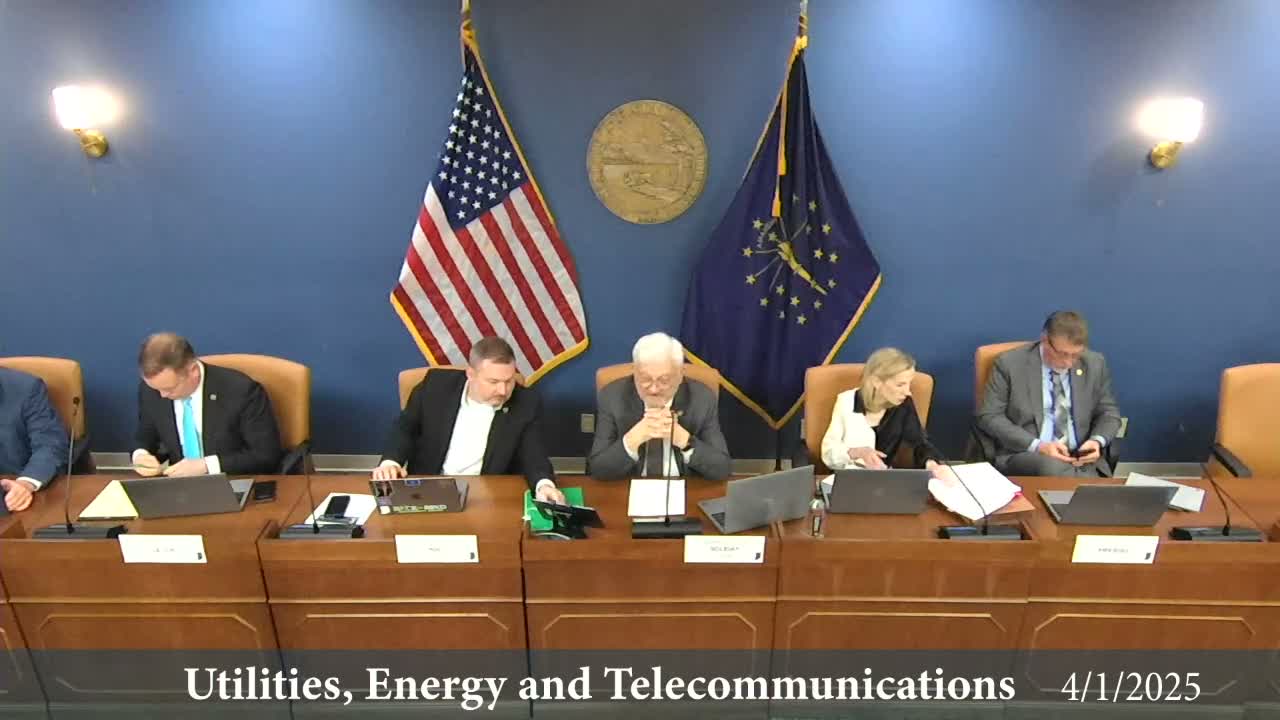
Senators and witnesses debated Senate Bill 423 on the development of small modular nuclear reactors (SMRs) during a hearing of the Utilities, Energy and Telecommunications Committee. Senator Cook, the bill’s author, described SB 423 as a state pilot program that would create a statutory pathway for utilities to partner with eligible third parties to develop SMRs and permit predevelopment cost recovery under review by the Indiana Utility Regulatory Commission (IURC).
The bill would allow an eligible utility to partner with customers, other utilities, capital partners, military installations, reuse authorities, SMR manufacturers or state educational institutions to construct SMRs. "The purpose of the pilot is ... to facilitate the development of SMRs and to reduce the cost and risk that would otherwise be borne by a single eligible utility," Senator Cook told the committee.
Supporters including Joseph Rampala of Indiana Industrial Energy Consumers and Matt Long of the Indiana Energy Association said SB 423 could enable innovative financing arrangements and reduce the burden on ratepayers by broadening risk-sharing and investment. "By opening up the opportunity clearly and precisely, Senator Cook has indicated for partnerships to be formed not just simply by utilities within the state, but with their customers and with others who can assist with the development of a new technology," Rampala said.
Opponents — including Delaney Barber Quan of Indiana Conservation Voters, David Van Gilder of the Hoosier Environmental Council and Kerwin Olson of CAC — cautioned that the bill allows upfront rate recovery of development costs without a guarantee a project will be completed. Quan said SB 423 "enables financial risk sharing between partners but does not require financial risk sharing," and argued that allowing recovery of planning costs before a project is built could leave Hoosiers paying for energy that is never produced.
Committee members asked detailed questions about how cost recovery would work and whether the statute is necessary if utilities already can form consortia and petition the IURC under existing law. Representative Pierce and Representative Prior pressed staff and commission representatives on whether third‑party contributions would be excluded from cost recovery and whether a project’s charges would appear as a separate line item on customer bills. Luke Wilson of IURC staff said the commission already has public notice requirements for hearings and that the bill codifies a framework the commission could apply, but he agreed to follow up with technical clarifications.
A chairman’s amendment (amendment 5) was offered to remove language that would have limited approved projects to no more than two eligible project sites; proponents said the cap might discourage partnerships and early movers, while critics said removing the limit would effectively eliminate the "pilot" nature of the program by allowing numerous sites. Senator Cook said he supported removing the cap to avoid unintentionally discouraging activity happening in the state.
Committee staff and many witnesses referenced procedural protections in the proposal: SB 423 includes a 180‑day review clock for IURC petitions and predevelopment cost‑recovery language similar to prior cost‑recovery measures. Senator Cook and other speakers noted an 80/20 structure discussed in related bills: roughly 80% of construction costs could be paid through the mechanism whether or not the project completes, while the remaining 20% would be recoverable only after a full rate case, though committee members and witnesses said those percentages and mechanics should be clarified by the commission and in technical drafting.
No final vote was taken. Chair Soliday told the committee he would "hold the bill" and schedule further consideration at the committee’s next meeting. The committee received technical and policy testimony and asked staff to clarify how the bill interacts with existing IURC rules and with third‑party contributions before returning to the measure.