Get Full Government Meeting Transcripts, Videos, & Alerts Forever!
Get email alerts on the Sustainability Policy topic
No spam. Unsubscribe anytime.
West Linn council and Sustainability Advisory Board discuss EV policy, LED upgrades and energy reporting
Summary
At a joint work session the Sustainability Advisory Board presented parametric recommendations—procurement policy for alternative‑fuel vehicles, LED upgrades, a municipal energy‑reporting baseline, EV chargers and funding strategies—while councilors emphasized staffing limits and asked the board to prioritize actions for the coming year.
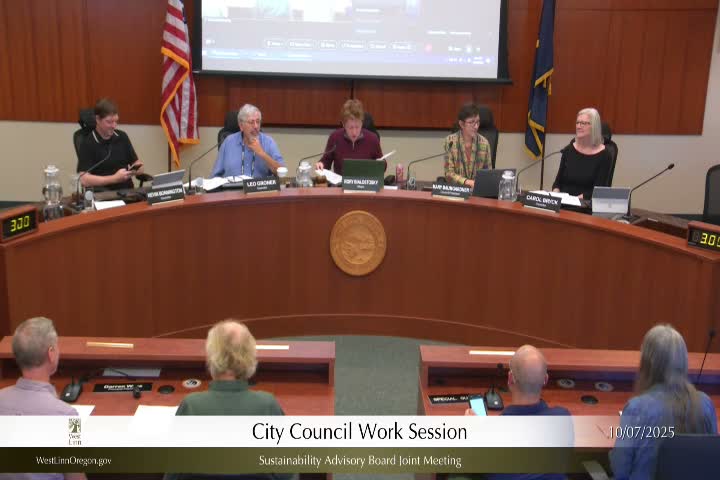
At a joint Oct. 7 work session, the West Linn City Council and the Sustainability Advisory Board (SAB) reviewed recommendations from a parametric consultant and discussed next steps for municipal sustainability work.
An SAB representative summarized the report’s main proposals: “develop a policy regarding a purchase of alternative fuel electric or hybrid vehicles, including cost‑benefit analysis for future purchases,” transition city facilities to LED lighting with tracking, evaluate sustainable building features for new public-works construction, explore public and commercial EV fast‑charging opportunities, and compile a directory of local repair services to encourage reuse.
SAB members also raised the prospect of municipal energy‑reporting for larger commercial buildings as a practical first step toward a baseline of greenhouse‑gas data. The board pointed to larger-city examples while acknowledging resource constraints: implementing building-efficiency reporting would require staff time or phased approaches.
Councilors generally supported the recommendations but cautioned that stronger language (for example, replacing “consider” with “commit”) carries budget and implementation implications. Council President Mary Baumgartner said such language must be clear and implementable; others urged that commitments be tied to staff capacity and funding. Dylan Digby, the city’s assistant to the manager and SAB liaison, confirmed staff possession of a draft alternative‑fuel vehicle policy and said LED replacements are occurring opportunistically as fixtures fail.
Council and SAB discussed near-term steps the city might take, including: prioritization guidance to the SAB at the council’s upcoming budgeting/priorities session; pursuing partnership opportunities for EV chargers (SAB suggested contacting Electrify America and Walmart); exploring federal solar-incentive timelines; and seeking grant opportunities for urban‑tree inventories and other tools.
The council asked staff to bring back prioritized language and options at the Oct. 21 work session. No formal council action was taken at this meeting; the joint session was framed as input and direction for SAB work planning.