Get Full Government Meeting Transcripts, Videos, & Alerts Forever!
Get email alerts on the State Legislation topic
No spam. Unsubscribe anytime.
West Linn’s legislative rep says special session passed slimmed transportation package; referral and short-term transit funds could complicate local budgets
Summary
Doug Riggs briefed the West Linn City Council on a special legislative session that produced a slimmed-down transportation package: a 6¢ gas-tax increase, higher registration fees and temporary payroll transit funding, removal of broad toll authority, and a likely ballot referral that could delay implementation and reduce expected local revenue.
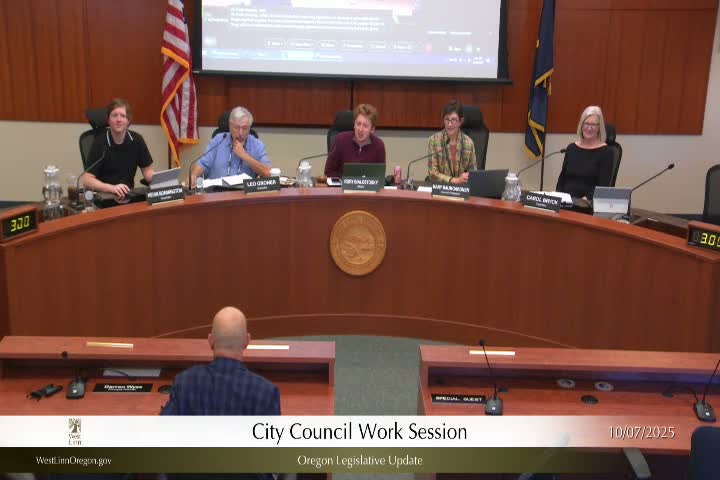
Doug Riggs, the city’s legislative representative, told the West Linn City Council on Oct. 7 that a recent multi-day special session produced a slimmed-down transportation package that could change revenue streams for cities and transit providers. “It does increase the gas tax by 6¢,” Riggs said, and the package also raises vehicle registration fees and adjusts EV fees to bring electric vehicles into the revenue base.
Riggs said the package preserved the long‑standing 50/30/20 distribution formula for funds and described several provisions that he and the League of Oregon Cities had prioritized. He also said the session produced a temporary payroll tax increase for transit that will sunset after two years, a change that some rural transit providers could find difficult because the transit payroll tax—though numerically small—was doubled and then set to expire.
The session also removed most of ODOT’s tolling authority, Riggs said, leaving tolling for the Columbia Crossing as the only remaining explicit tolling power in the package. “The authority for ODOT to impose tolls on anything except for the Columbia crossing is now eliminated,” he said.
Riggs cautioned the council that political opponents of the package are widely expected to pursue a ballot referral. Under state rules, the governor has 30 days to sign the bill; opponents then have 90 days from passage to gather the signatures required to refer measures to the ballot. Riggs said proponents expect to wait until the final day so signature-gatherers will have about 60 days, and that subjects targeted for referral might be a subset of the package (for example, the gas tax or the payroll tax alone). He estimated supporters are likely to target roughly 110,000 signatures to account for the sample-based validation that can disqualify some signatures; the statutory threshold to place a referral on the ballot is about 78,000 valid signatures.
Council members pressed Riggs for guidance on how the package might translate to municipal revenue. Riggs said ODOT must still run technical calculations to estimate city-level shares and that some revenue could be delayed if parts of the package are referred and the state decides not to begin collecting elements that are likely to be on the ballot.
Riggs placed the legislative developments in a larger fiscal context: the state’s revenue forecast showed a substantial downturn and the governor had already asked agencies to reduce discretionary spending. He said Medicaid and other major state programs remain the most significant fiscal pressures going into the next short session. “Fasten your seat belts,” Riggs told the council, predicting a busy off-year for policy and budget work.
Next steps: Riggs recommended that West Linn continue outreach with state legislators and that the council track the secretary of state filing for any formal referral so the city can better estimate timing and revenue impacts.