Get Full Government Meeting Transcripts, Videos, & Alerts Forever!
Get email alerts on the Municipal Procurement topic
No spam. Unsubscribe anytime.
Dardenne Prairie administrator seeks first reading of new purchasing code to raise bid thresholds
Summary
City Administrator Kathy Pratt asked the Board of Aldermen to give a first reading to an ordinance (Bill 2601) that rewrites Article 5 of the purchasing code, raises formal bid advertising to $20,000, sets new spending thresholds, defines 'lowest responsible bidder,' and adds an automatic inflation adjustment.
City Administrator Kathy Pratt presented a proposed rewrite of the city purchasing code, saying, “Our purchasing code has not been updated since 2007,” and asked the Board of Aldermen to consider a first reading of ordinance Bill 2601.
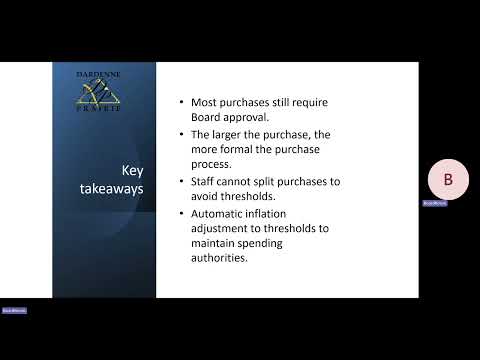
The draft would replace Article 5 in its entirety and includes expanded definitions, clearer procurement rules and thresholds, and an automatic inflation adjustment intended to keep spending authorities current. Pratt told the board the proposal raises the formal advertisement threshold to $20,000 and defines the standard as the “lowest responsible bidder” rather than simply the lowest bid.
Pratt outlined proposed approval authorities under the draft: purchasing-agent approval for purchases under $10,000; routine operating expenses up to $15,000 (with board approval required if not budgeted); minor capital expenditures up to $25,000; emergency expenditures up to $50,000; and a cap for minor professional services at $10,000. She also said the draft contains anti-splitting language to prevent staff from dividing purchases to avoid thresholds.
Board members asked how the changes would affect everyday purchases and internal controls. One alderman asked whether the policy covers city credit cards; Pratt replied it does not change the administrative card policy itself but said, “the purchasing policy applies no matter how you make the purchase,” and that she and Finance Manager Kim Clark review card limits, require receipts, and maintain low dollar limits.
Several members raised concerns about raising non-board approval thresholds, especially for routine or budgeted expenses. One alderman questioned whether budgeted event spending—Pratt noted the Fourth of July has a budgeted line of $52,000—could bypass board oversight; Pratt clarified that budgeted items would continue to be spent without separate board approval unless an individual purchase exceeded its budgeted amount. Another member urged higher emergency spending authority so urgent repairs (HVAC, boilers, elevators, vehicles) can be addressed between meetings.
Pratt said she would review 2024–2025 purchases and work with staff to provide additional context on how often purchases would reach the new thresholds. She concluded by requesting a first reading of Bill 2601; the board discussed procedure and indicated comfort proceeding with a first reading although no formal roll-call vote was recorded.
The board did not adopt the ordinance at the meeting; the item was placed for a first reading and staff were asked to return with background on past purchasing activity and any clarifications the board requests.